

Have you ever felt completely sure you were right about something, only to realize later that you were dead wrong? Or, conversely, have you ever found yourself knowing way more about a topic than you initially gave yourself credit for? The human mind is a master of both self-deception and bending reality to suit its needs. This is exactly where Cognitive Dissonance Theory and the Dunning-Kruger Effect come into play. Today, we’re going to take a closer look at these two concepts together!
In a nutshell, these two ideas explain why we cling to incorrect beliefs, why we sometimes think we’re smarter or more capable than we actually are, and why we find it so difficult to admit when we’ve made a mistake. Let’s dive in and explore the games our minds play on us.
Cognitive Dissonance Theory
Let’s start with our first concept! At first glance, the name doesn’t tell us much, does it? If you asked me to summarize it in three words, you could just look at the title. If you want a longer explanation, keep reading!
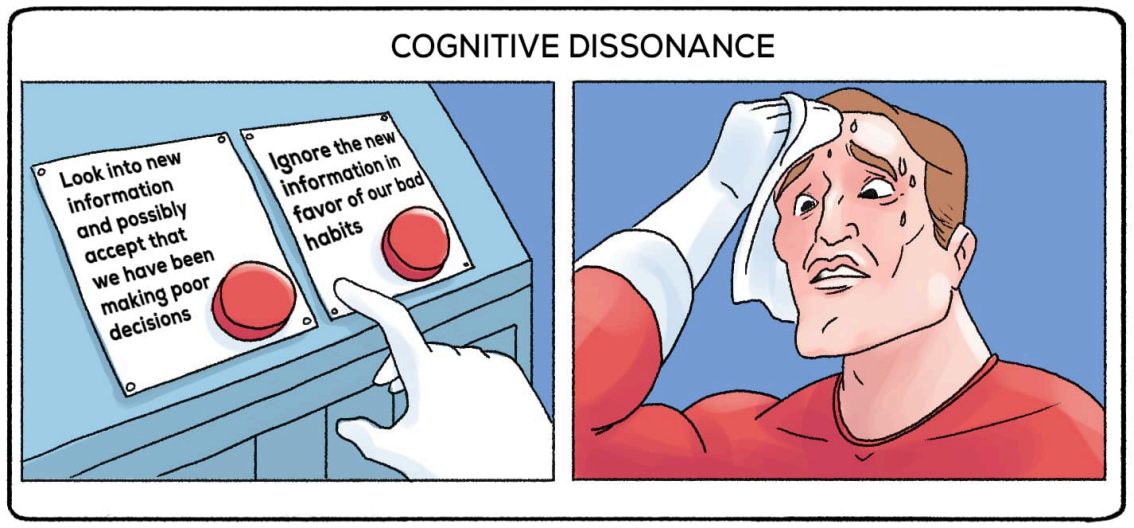
Our first stop is Cognitive Dissonance Theory. When Leon Festinger proposed this theory in 1957, he suggested that people who experience an inconsistency between their beliefs and their actions feel a sense of cognitive tension. To soothe this uncomfortable friction, our minds develop various defense mechanisms. But what was the basis for Festinger’s claim?

Festinger brought participants together to observe this phenomenon. The subjects were initially told they would be taking part in a fun experiment about motor skills, but instead, they were met with incredibly monotonous and boring tasks. Once the participants finished, frustrated and bored, the researchers asked them to do something surprising: tell the other subjects waiting in line that the tasks were actually quite fun. Of course, you wouldn’t expect people who had just spent an hour yawning to agree to this for no reason. Festinger’s team split the participants into two groups, paying one group $1 and the other $20 to tell the next subjects that the experiment was fun. Which group do you think changed their opinion about the experiment?
You might be guessing the group that got $20, but you’d be wrong. The $1 group was much more likely to start thinking that the task was actually fun. Why? Because the small reward wasn’t a strong enough justification for lying. They essentially thought, “If it was truly that boring, why would I do this for just a dollar?” To resolve that internal tension, they shifted their beliefs, telling themselves, “Maybe it wasn’t that boring after all.” By changing their internal narrative, they reduced their cognitive dissonance. They chose to believe the lie rather than admit they were the kind of person who would lie for chump change.
On the other hand, the group that received $20 had a perfectly logical reason for their lie (the money), so they didn’t feel the need to alter their beliefs to justify their behavior.
What if I told you the human brain does this all the time? Think about it: when you’re on a diet but eat fast food, you tell yourself, “Oh, it’s just one time, it won’t hurt!” Or when you do something wrong and deflect by saying, “At least I don’t drink or smoke!” Or perhaps when someone else gets a high grade on an exam you failed, you scoff, “I could have done that too if I’d actually studied!” These are all ways we resolve cognitive dissonance to keep ourselves feeling psychologically comfortable.
The Dunning-Kruger Effect
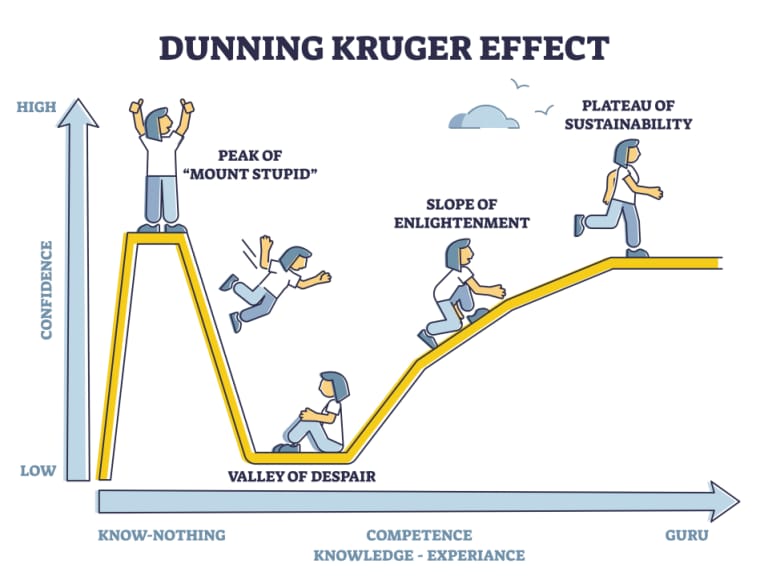
Now for our second stop! We’ve arrived at a place that relates to cognitive dissonance in many ways. This phenomenon was identified by David Dunning and Justin Kruger in 1999. It suggests that individuals often misjudge their own competence and knowledge levels, leading them to view themselves as better than they actually are. The effects of this syndrome generally manifest in three ways:
- Overconfidence!: Individuals with low competence fail to realize just how incompetent they are, leading to inflated self-confidence.
- Realistic Hesitation: Those with moderate knowledge start to recognize their own limitations, which often leads to a dip in their self-confidence.
- The Humble Delusion: Highly competent individuals often assume that others are just as knowledgeable as they are, leading them to undervalue their own expertise.
When Dunning and Kruger asked people to evaluate their own performance in various areas (logic, language skills, sense of humor, etc.), they found that the least competent people were the ones who gave themselves the highest scores.
The most striking example of this is the case of McArthur Wheeler. In 1995, Wheeler robbed a bank with lemon juice on his face, believing that because lemon juice is used in invisible ink, it would make him invisible to security cameras. When he was caught, he was genuinely baffled, exclaiming, “But I wore the juice!” He couldn’t comprehend why his plan failed. It’s obvious that Wheeler had a glaring gap in his knowledge, isn’t it? Yet, he proceeded with such a bold act without a shred of doubt.
If we look at modern examples, we see this constantly on social media, where people try to “correct” genuine experts in their fields. While this effect can lead people astray, for those with self-awareness, it can actually be a stepping stone. Incompetent individuals with over-the-top confidence will eventually hit a wall. That moment of failure often triggers a realization, followed by a desire to learn and grow. In the end, they can evolve into someone who is truly competent.
Both Festinger’s work and the Dunning-Kruger Effect show us a clear truth: we lie to ourselves!
Understanding these two psychological phenomena can help us look at the world with a more critical eye. Are we really as competent as we think we are? Or is our brain setting traps to protect us from our own mistakes?
With this article, we’ve acknowledged our own blind spots. Now, whether we continue to believe our own lies or choose to grow is entirely up to us!
References and Further Reading
McLeod, S. (2025, June 20). Cognitive dissonance in psychology: Definition and examples. Simply Psychology. https://www.simplypsychology.org/cognitive-dissonance.html
Sprouts. (2021, March 31). The Dunning Kruger Effect [Video]. YouTube. https://www.youtube.com/watch?v=4FGnb2lgPBA
The Editors of Encyclopaedia Britannica. (2025, September 27). Dunning-Kruger effect. Britannica. https://www.britannica.com/science/Dunning-Kruger-effect
The Editors of Encyclopaedia Britannica. (2025, September 20). Leon Festinger. Britannica. https://www.britannica.com/biography/Leon-Festinger/Cognitive-dissonance
Originally published in Turkish at Doğa Filozofu.