

You wake up one morning and decide you want a sweet cookie with your coffee. So, what do you do? Do you eat it right away because you’re craving it, or do you hold back for the sake of your health? And here’s a tougher one: if an authority figure told you to cause harm to a total stranger, would you actually do it?

Behind the decisions we make every day—whether big or small, and often without realizing it—lie unconscious mechanisms, social pressures, and biological predispositions. Is it possible that something as simple as resisting a marshmallow could determine our future success? Or can our respect for authority actually silence our conscience? In this piece, we’re going to dive into the most striking psychology experiments that reveal the inner workings of self-control, obedience, learned behavior, and decision-making. And for that, we can start at our first stop: the Marshmallow Test!
The Marshmallow Test
Let’s say there’s a delicious-looking treat sitting in front of you. You’re told, “If you wait 15 minutes, you’ll get another one!” What do you do? Can you hold out, or would we come back to find an empty, crumb-free plate the moment we turned our backs? This is the exact question Walter Mischel sought to answer in his famous Marshmallow Test at Stanford University in the late 1960s. Of course, the experiment wasn’t really about the snack; it remains one of the most fascinating studies to establish the scientific link between patience, self-control, and future success.

So, how does this test work? Let’s take a look!
In Mischel’s experiment, children between the ages of 3 and 5 were placed in a room with a single marshmallow. They were given a simple choice: if they didn’t touch the marshmallow for 15 minutes, they would earn a second one. If they ate it right away, they wouldn’t get the extra reward.
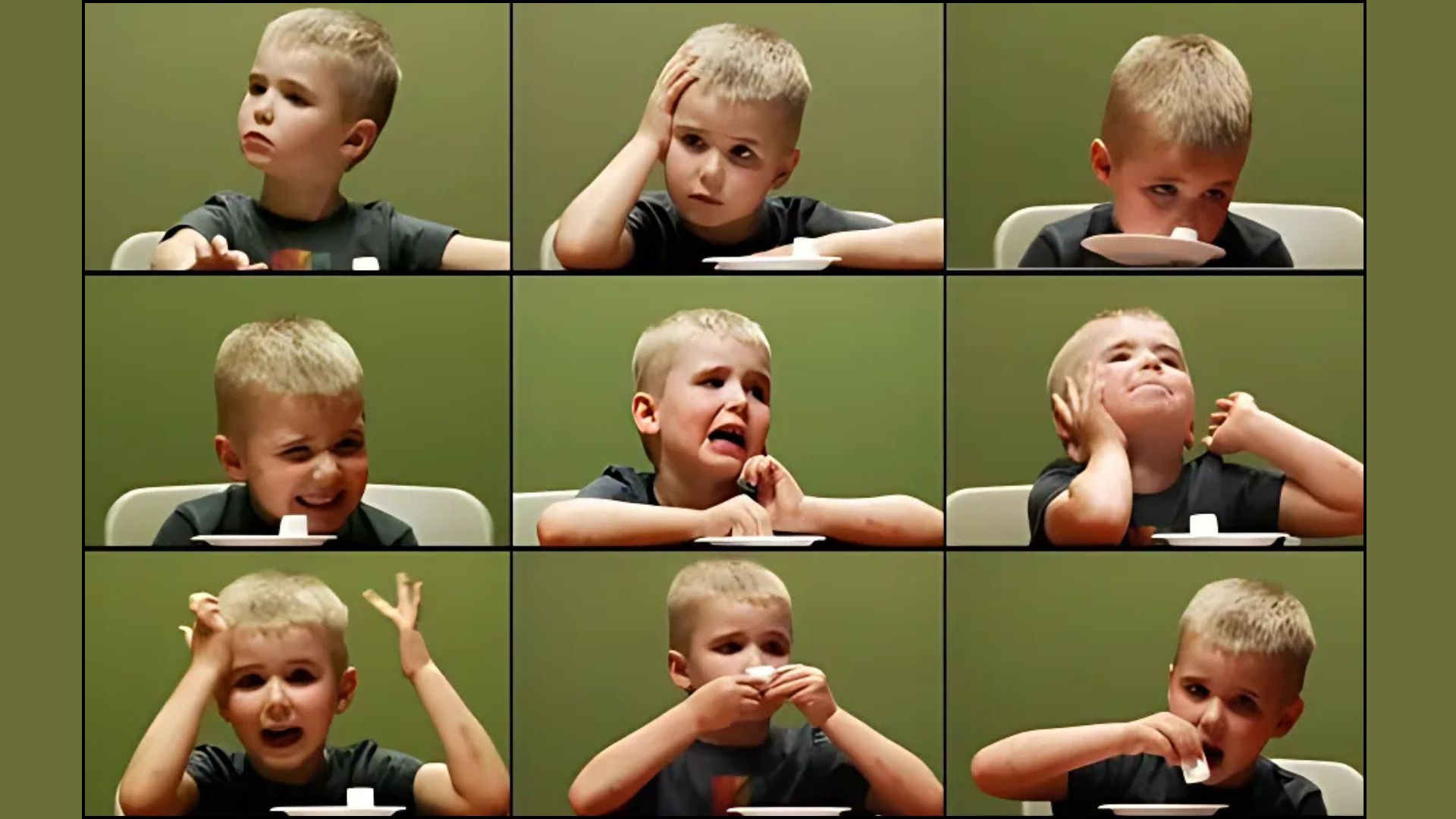
The goal was to test the children’s capacity for self-control and their ability to think long-term. But Mischel and his team realized there was more to it. When they followed up with the participants in 1990, they found that those who had the patience to wait generally achieved better academic results, built healthier relationships, and handled stress more effectively.
But here’s the question: did these children wait because they genuinely wanted a second marshmallow, or because they were afraid of defying authority? This brings up an interesting point. What motivates us more: the reward, or the fear of getting in trouble?
This is exactly where the Milgram Experiment comes in. Since we’ve touched on this concept in our previous articles, we won’t go into full detail here, but it’s worth mentioning because of its undeniable connection to this topic. In this experiment, participants were instructed to deliver electric shocks to another person (who was actually an actor). No real shocks were administered, but the actor would react as if they were in pain. A significant portion of the participants said they weren’t enjoying it and wanted to stop, but the researchers firmly told them to continue. Most participants kept delivering higher voltages simply because the researcher said “please continue.” This sheds some light on the dilemma of the Marshmallow Test: it shows that humans often have a greater need to satisfy authority than to satisfy their own desires. But what happens to these “patient” and “well-behaved” children when they eventually become the ones in authority?

Many systems—schools, workplaces, traditional marriages—value compliance, don’t they? Those who adapt to existing conditions, follow instructions to the letter, and don’t push back are labeled “successful” and “well-adjusted.” Individuals who grow up doing this often become pillars of society. A good accountant, teacher, or student is considered “good” under these conditions. But what happens when they become the authority themselves? That brings with it an undeniable burden and a tendency toward aggression.
The Stanford Prison Experiment
Now we enter the darker territory. So far, our journey has been filled with “compliance,” “respect for authority,” and innocent childhood giggles. But once someone steps into a position of authority, the metrics of success—and the scope of their influence—shift. In 1971, Philip Zimbardo designed an experiment similar to Milgram’s to see how authority changes people: the Stanford Prison Experiment.

We’ve covered this experiment in a previous piece, but to keep the thread of our discussion intact, let’s summarize it briefly. In the Milgram experiment, the authority was someone else, but in this one, the subjects themselves became the authority. Participants were randomly assigned to be either prisoners or guards. Both sides knew they weren’t actually in a real prison. Even so, the “guards” began to act more harshly and oppressively toward the “prisoners” with each passing day. Within just four days, the “prisoners” began to suffer psychological breakdowns, and the experiment, intended to last two weeks, had to be shut down on the sixth day.
This experiment showed us how quickly social roles and the weight of authority can lead people to do things they would never otherwise consider. As you might guess, people don’t necessarily need a grand seat of power to start exerting it. If given the chance to dominate, a significant number of people will take it and use that power against anyone they perceive as being in a lower position. So, what does a child do when they see this kind of authority? The answer is simple: they imitate it!
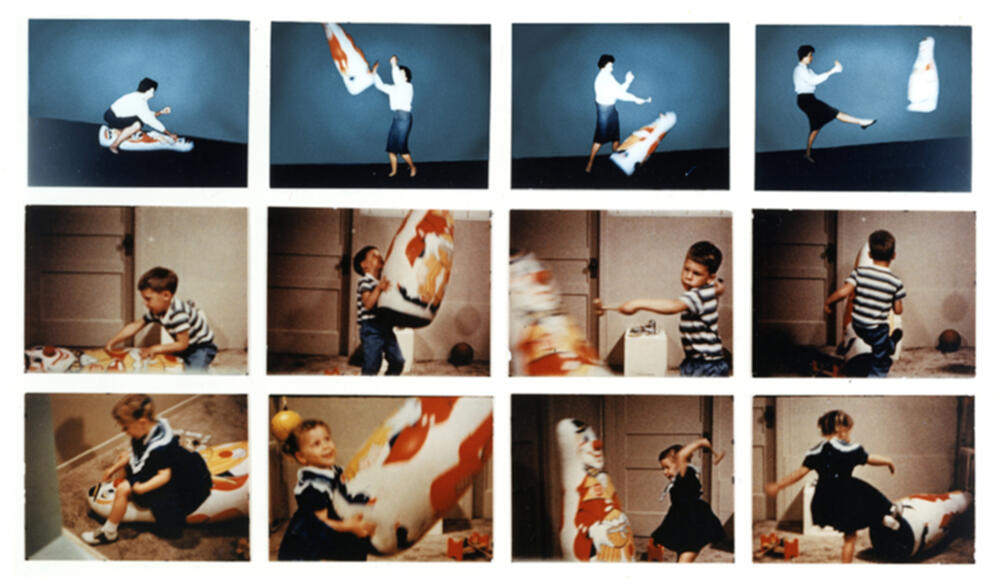
Source: Children strike back – Bobo doll experiments
The Bobo Doll Experiment
Let’s assume there’s a parent who has adopted this “guard” persona in real life. They come home, they yell and scream, or they fly off the handle easily. They break things. Even if we assume they aren’t doing anything to the child directly, keeping them out of the line of fire, what happens? That’s exactly what the Bobo Doll experiment set out to measure.
In this study, children watched an adult hit and behave violently toward an inflatable Bobo doll. The children weren’t given any instructions. The adults didn’t pressure or push the children in any way. Yet, the children who watched the violence began to hit, kick, and damage the doll themselves. And if you’re thinking, “Is that just an annoying-looking toy? Maybe it had a face that deserved it?”—believe me, that wasn’t it. A separate group of children who hadn’t witnessed the violence played with the doll perfectly fine without causing any harm. This proved that children were imitating the actions they saw, driven by their innate need to adapt to the “authority” around them.

So, what do all these experiments teach us? We need to be brave enough to question whether the decisions we make are truly the product of our own free will. Sometimes we pass a test of patience like a child; other times, we lose sight of our moral boundaries in the shadow of an authority figure. Our environment, our upbringing, our biological tendencies, and social norms shape us from our simplest choices to our biggest life decisions. By using this knowledge consciously, we can make more aware, resilient, and perhaps even freer decisions—because our choices are never just ours alone; they are a collective product of all the forces that built us.
Perhaps the most important question is this: does knowing this change how we make choices in the future?
References and Further Reading
Conti, & Regina. (2014, November 4). Delay of gratification | Psychology, Self-Control & Benefits. Encyclopedia Britannica. https://www.britannica.com/science/delay-of-gratification#ref1206154
Eldridge, & Stephen. (2025, July 17). Milgram experiment | Description, Psychology, Procedure, Findings, Flaws, & Facts. Encyclopedia Britannica. https://www.britannica.com/science/Milgram-experiment
Everywhere Psychology. (2012, August 28). Bandura’s Bobo Doll Experiment [Video]. YouTube. https://www.youtube.com/watch?v=dmBqwWlJg8U
Nolen, & L, J. (2009, October 6). Bobo doll experiment | Description, Methodology, Results, & Facts. Encyclopedia Britannica. https://www.britannica.com/event/Bobo-doll-experiment
The Editors of Encyclopaedia Britannica. (2025, July 21). Stanford Prison Experiment | History & facts. Encyclopedia Britannica. https://www.britannica.com/event/Stanford-Prison-Experiment
Originally published in Turkish at Doğa Filozofu.