
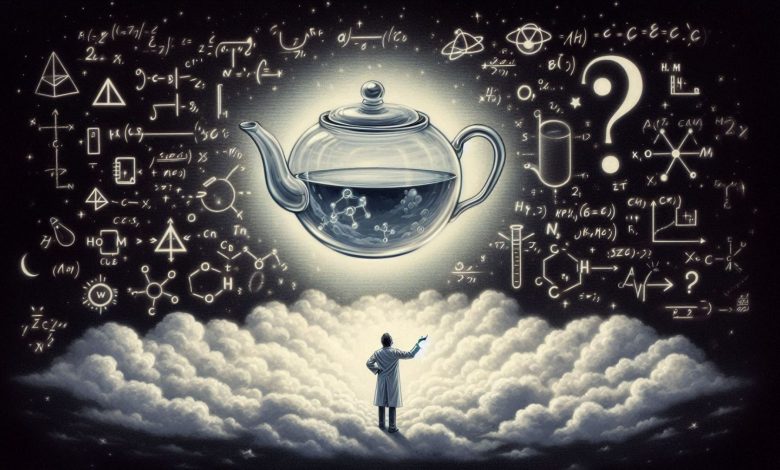
Imagine someone claims there is a tiny teapot floating in the middle of space, far too small for anyone to ever see. It’s so far away, in fact, that even our most powerful telescopes couldn’t possibly detect it. Now, what reason would you have to believe this claim is true? Bertrand Russell used this thought experiment to deliver a pretty significant critique regarding belief in God. Russell’s teapot isn’t just about kitchenware; it’s a deep dive into logic and faith: Shouldn’t something be provable before we accept that it exists?
In this piece, we’re going to explore both Russell’s narrative and what kind of answer there might be to this question!
Russell and the Teapot
As one of the most important philosophers of the 20th century, Russell made major contributions to logic, mathematics, and the philosophy of science. His work on philosophical agnosticism and atheism, particularly his critiques of religion and belief in God, left a lasting mark. So, yes—Russell was an atheist, and he’s well-known in the history of philosophy for his writings on the subject.
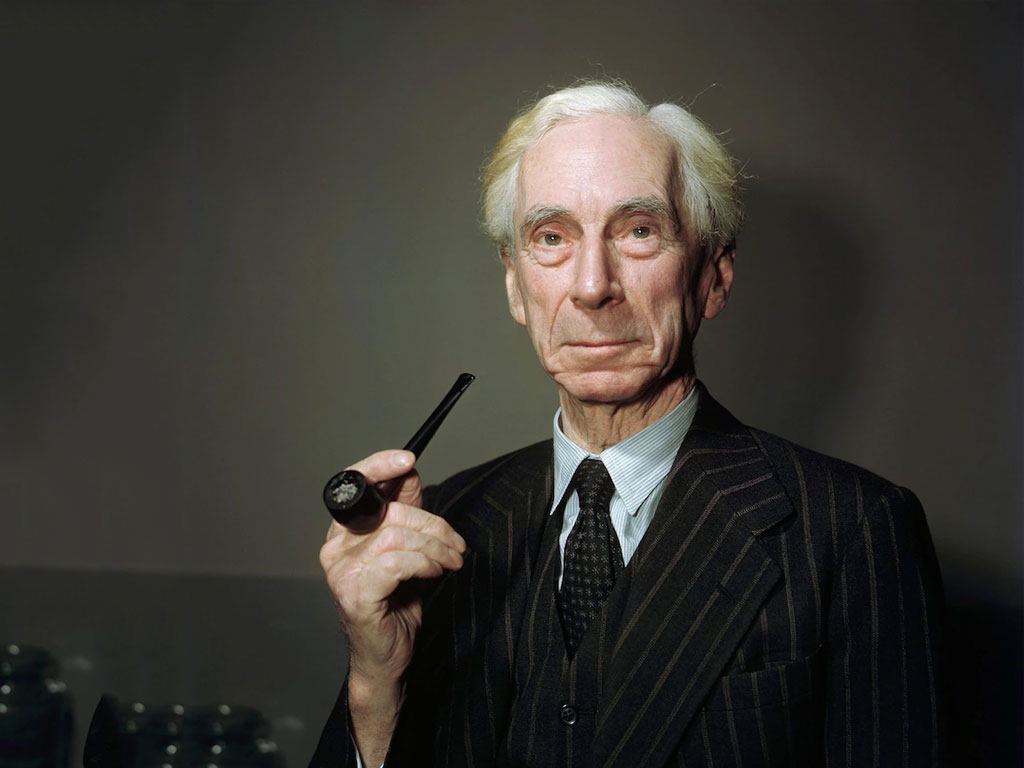
In a 1952 article for *Illustrated Magazine*, Russell used the “teapot” analogy to develop a compelling counter-argument against popular arguments for the existence of God. This analogy has since become a classic example highlighting the principle of the “burden of proof.” But what is this teapot all about?
Russell uses the example to make his point. Suppose there is a tiny teapot orbiting between Mars and Earth, but it’s so small that even our strongest telescopes can’t see it. According to Russell, if someone claims this teapot exists, others are perfectly justified in not believing them, because the person making the claim is the one who bears the burden of proving it exists. If they turn to the skeptics and say, “You can’t prove the teapot *doesn’t* exist, therefore it must exist,” that reasoning is flawed. At least, that’s what Russell believed.
This analogy was specifically designed as a critique of theistic arguments that suggest God exists simply because there is no absolute proof that He doesn’t. Of course, here at *Doğa Filozofu* (The Nature Philosopher), our goal isn’t to debate this from a religious perspective, but to point out how this example impacts science. After all, in the history of philosophy, the “green swan” example is a counterpoint to this: it suggests that saying “green swans don’t exist” is wrong because you cannot prove the non-existence of something. So, without getting lost in the weeds of the philosophy of religion, let’s take a look at the place this example holds in science!
Russell’s Teapot in Science
In a scientific sense, Russell’s teapot example questions the very foundations of scientific thought and logical argumentation. One of the most fundamental principles in science is the principle of verifiability and falsifiability. According to this, a scientific hypothesis or theory must be testable through observation and experimentation. Russell’s teapot analogy highlights these principles in a concrete way.
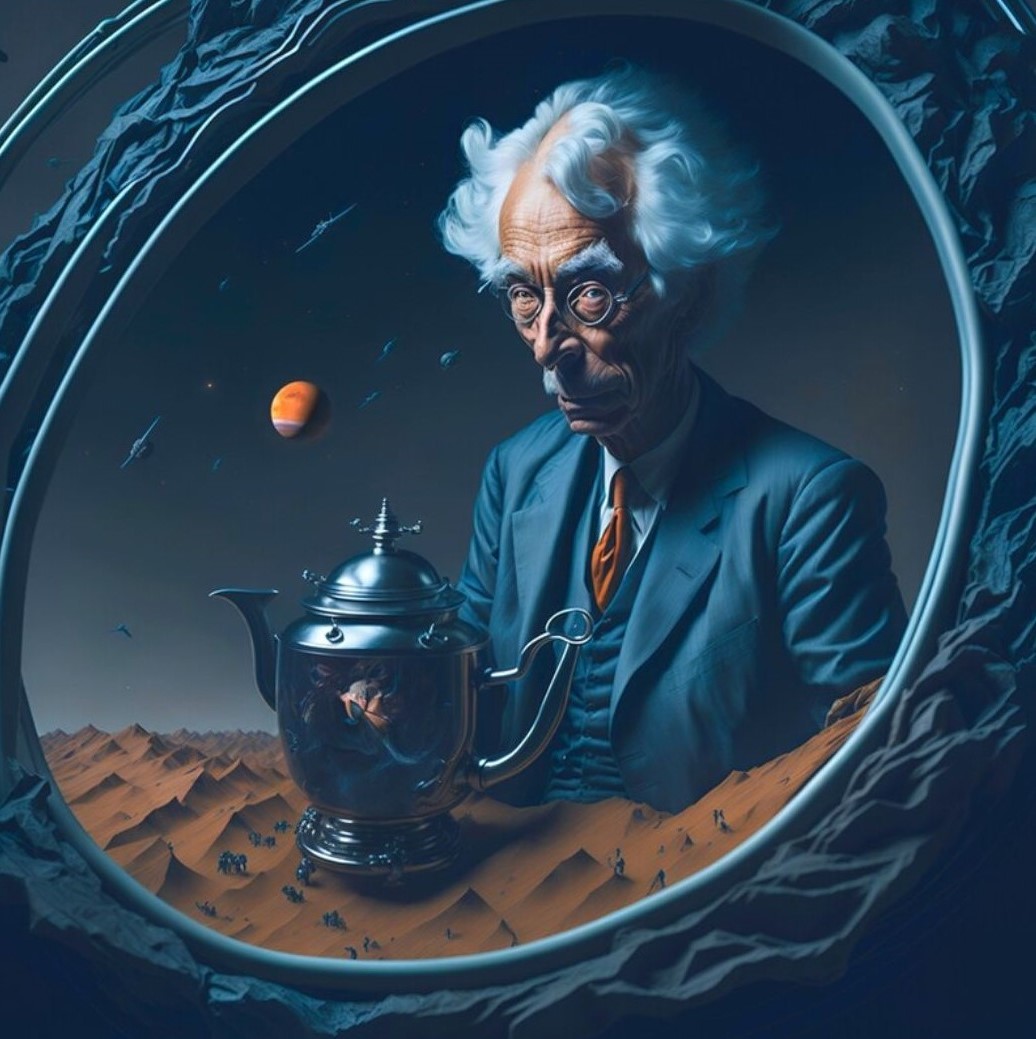
Russell’s metaphor stands as a counter-argument to metaphysical claims—like the existence of God—that cannot be observed or directly proven. The teapot is an object impossible to evaluate scientifically because an unobservable teapot falls outside the boundaries of science. Furthermore, if there is no evidence for a claim, it cannot be accepted as scientific. In science, evidence is mandatory; otherwise, the validity of the claim will be questioned by the scientific community. Of course, science doesn’t say “the teapot does not exist,” either. Rather, it adopts a position based on the fact that its existence has not been proven. For the same reason, it is more accurate to say, “We have no evidence for the existence of aliens yet,” rather than, “Aliens do not exist.”
In this sense, the teapot metaphor isn’t about blind denial; it’s an example of scientific skepticism. The scientific method requires us to seek solid evidence for the truth of a claim before accepting it. With this metaphor, Russell emphasizes the principle of the ‘burden of proof’. A claim is only taken seriously and tested as a ‘hypothesis’ when the person proposing it provides sufficient evidence. Until it is proven, the claim doesn’t even come close to being a ‘scientific theory.’
This metaphor of Russell’s has influenced many fields and thinkers. Philosophers like Richard Dawkins, Daniel Dennett, and Sam Harris have all used this analogy to support their own narratives.
Ultimately, Russell’s teapot provides an important framework for understanding the limits of scientific thought and the importance of solid evidence. In science, believing in something without valid evidence is simply not a scientific approach. This applies not only to metaphysical claims or religious beliefs but to any claim that is unobservable and untestable.

In science, hypotheses must be supported by evidence and be falsifiable. The teapot example is based on these principles. If a claim cannot be tested through observation or if no concrete evidence can be presented, it cannot be considered scientifically valid. This is a question not only for invisible or untestable phenomena but also for events that might have huge impacts but remain unpredictable. In other words, accepting that claims without proof lack scientific value helps us build scientific thought on a much firmer foundation.
Russell’s teapot highlights the importance of scientific inquiry and the validity of the principle of provability through observation. Being able to test what we believe and support it with evidence is a core element of scientific thinking. If that evidence is absent, believing something is true is nothing more than a mental habit. This example helps us understand how a lack of evidence and observation leads us to question the validity of a scientific claim.
References and Further Reading
Carneades.org. (2021, March 1). What is Russell’s Teapot? (Thought Experiment) [Video]. YouTube. https://www.youtube.com/watch?v=FsN3DCCTqpo
Furberg, L. (2010, November 3). Why god isn’t really a teapot. Practical Ethics. https://blog.practicalethics.ox.ac.uk/2010/11/why-god-isnt-really-a-teapot/
Russell, B. (1952). The problems of philosophy. Oxford University Press.
The Editors of Encyclopaedia Britannica. (2025, October 29). Bertrand Russell. Britannica. https://www.britannica.com/biography/Bertrand-Russell
Wikipedia contributors. (2025, October 8). Russell’s teapot. Wikipedia. https://en.wikipedia.org/wiki/Russell%27s_teapot
Originally published in Turkish at Doğa Filozofu.