
In today’s world, how do we distinguish what’s real? Are the things we see on our TV screens, social media feeds, and massive billboards a reflection of the truth, or are they just masterfully crafted, realistic scenes?
Thousands of years ago, Plato, one of history’s greatest philosophers, sought to answer this question with an allegory about people chained in a cave who mistook shadows for reality. Centuries later, Jean Baudrillard argued that the shadows of the modern age no longer live on cave walls, but on our screens and in our images. In this piece, we’ll dive into Plato’s narrative on reality, then turn our gaze to Baudrillard’s critique of the modern world.
Plato’s Allegory of the Cave
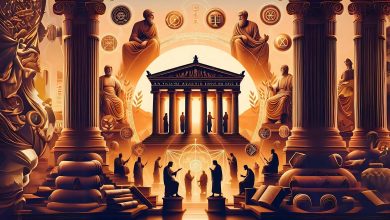
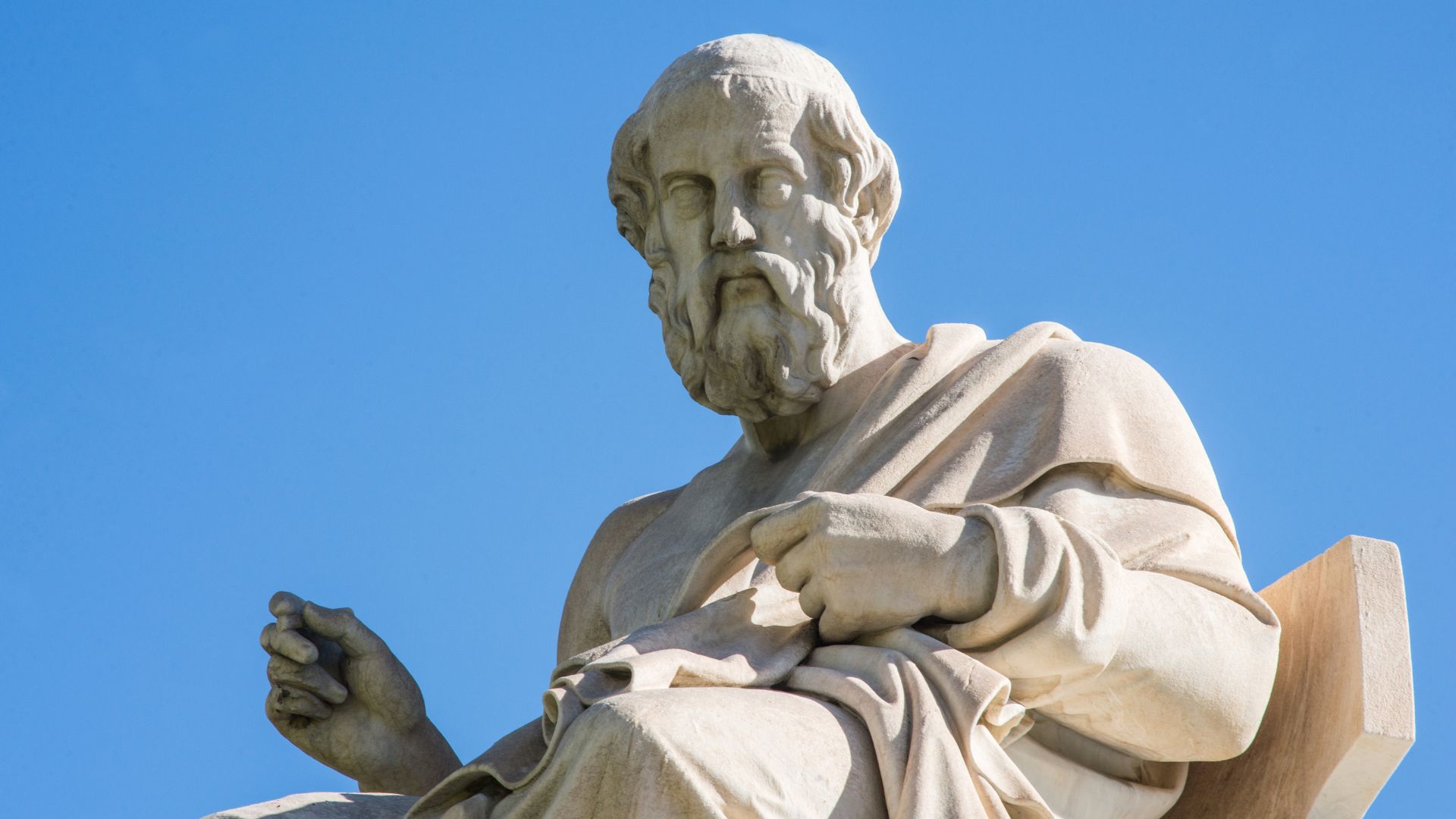
We’ve written a detailed piece on Plato before. Our attentive readers might remember it, and the allegory of the cave mentioned there will likely sound familiar. Still, let’s take a fresh and more detailed look at it here. Plato believed in the existence of a world of ideals, arguing that the reality we perceive and the reality that truly exists are not one and the same. To illustrate this, he presents a story—told through the voice of Socrates in his work, The Republic.
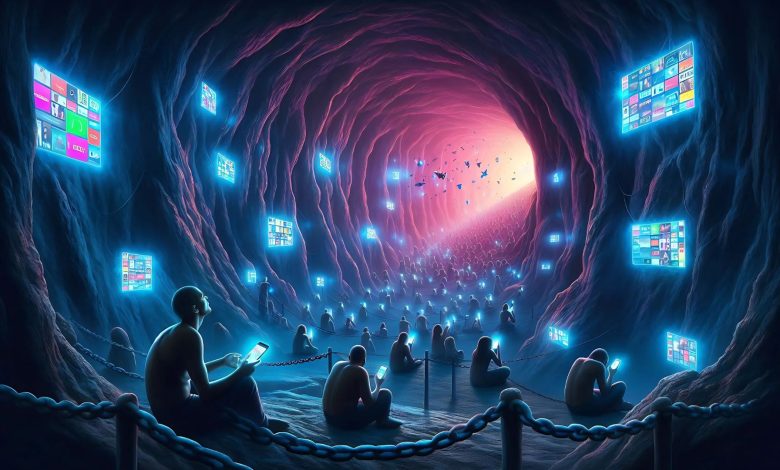
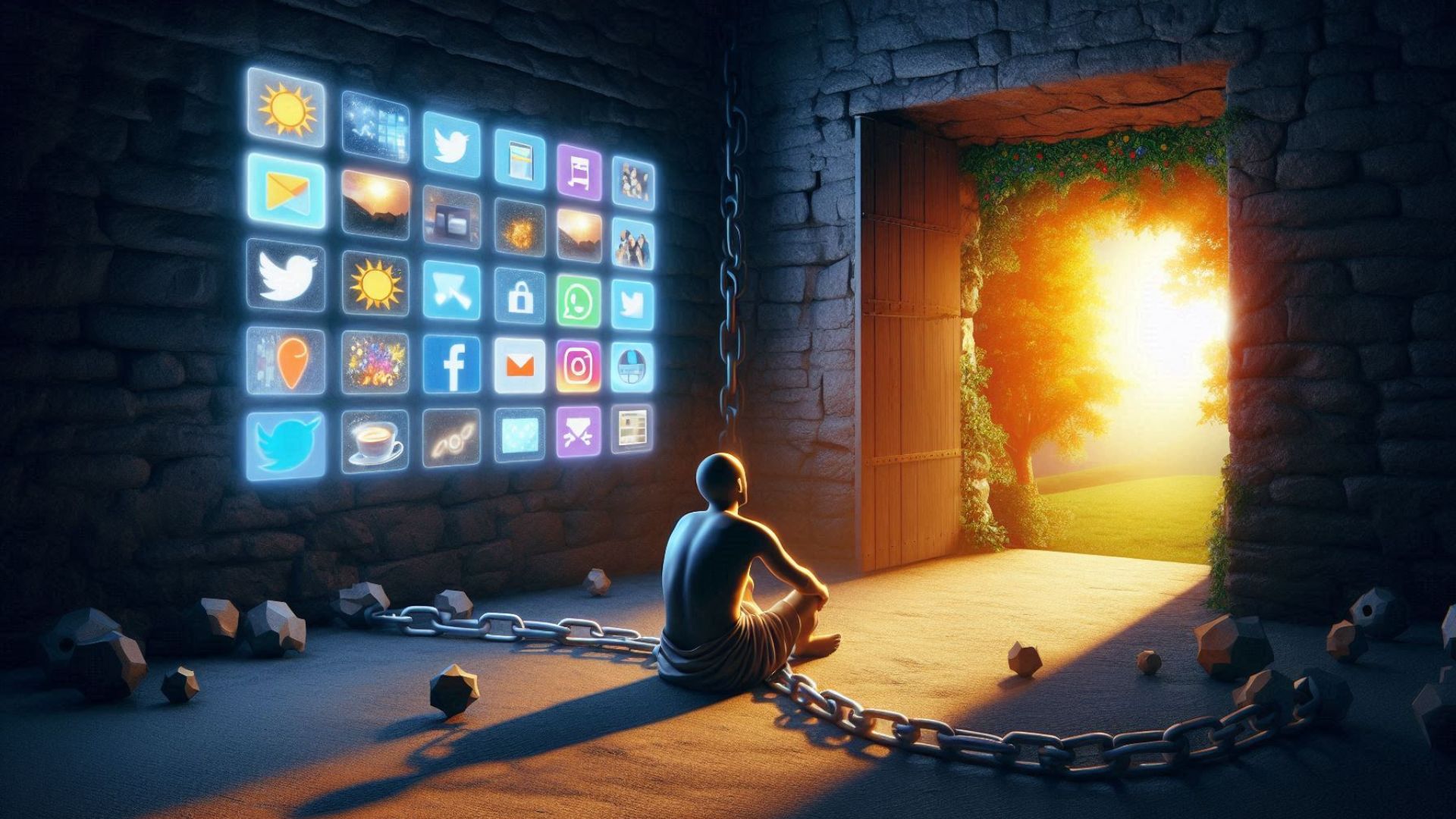
In this story, a group of prisoners is held captive in a cave. The catch? They were born there. They have never seen the outside world. They are chained in such a way that they must stay in a fixed, upright position, staring at the cave wall directly in front of them. Behind them burns a fire, and because objects are passed back and forth, only shadows are cast onto the wall. These people accept the shadows as reality because they have no other frame of reference. Having never seen the sun, tools, or natural phenomena, they believe these shadows are the real deal. Since the shadows only exist when the fire is lit, they treat the fire as their sun. For them, this is the sum total of existence, and they grow old in this cave.
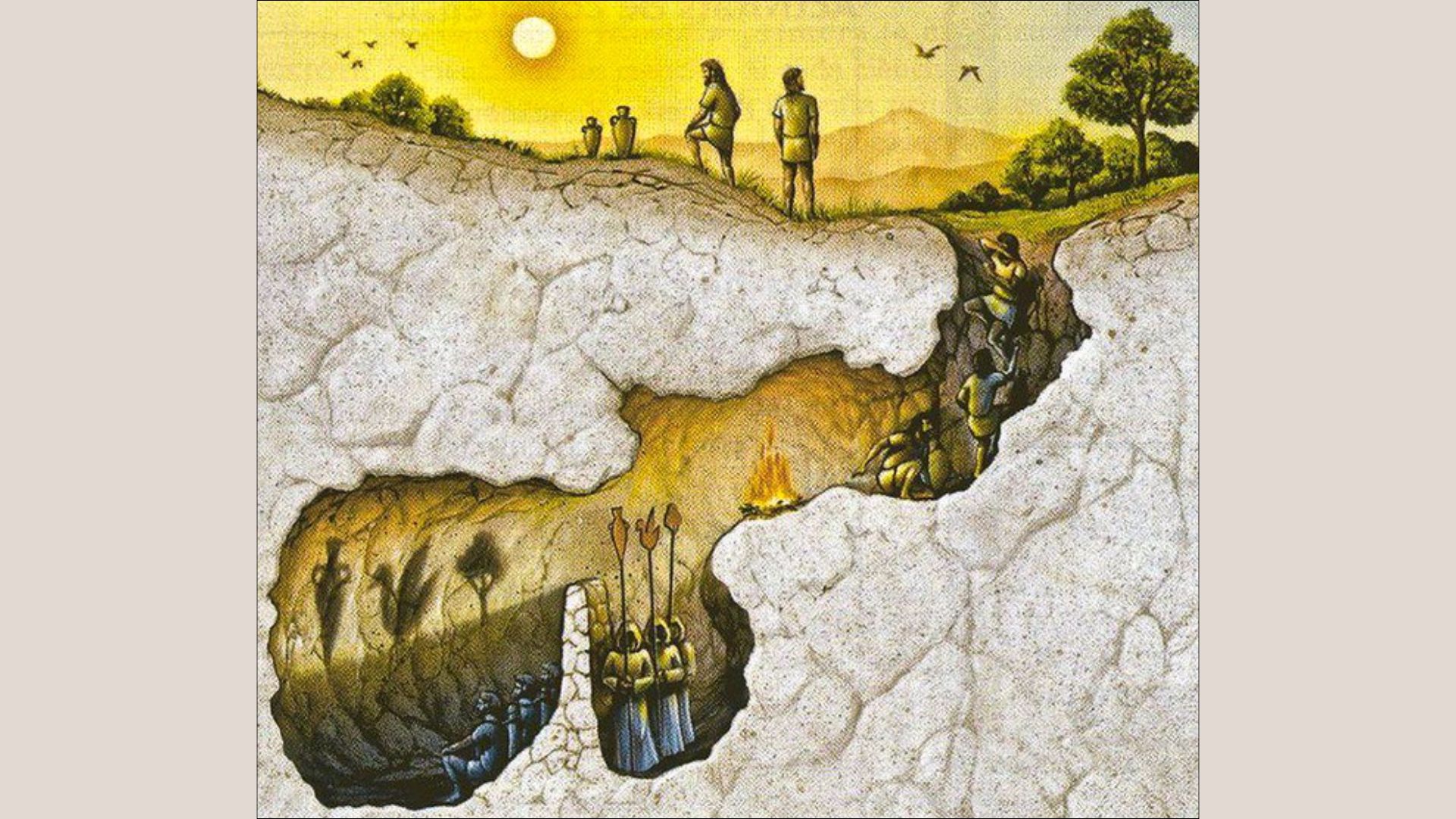
One day, one of them breaks free, ventures outside, and realizes that what they saw on the wall were merely shadows. He encounters trees, the real sun, and a vibrant spectrum of colors. At first, he is dazzled; the light of the fire and the sight of real objects are painful to his eyes. He realizes that what he is seeing is vastly different from the shadows he mistook for truth for so many years. In his astonishment, he steps out further and meets the brilliant light of the sun. Though his eyes struggle to adjust, he eventually understands that outside the cave, it isn’t shadows that exist, but real, tangible objects. When he sees the sky, the trees, the water, and the sun, he realizes that everything he believed in the cave was just an illusion. Once he sees the truth, he wants to go back to his old friends to set them free. But upon returning, his eyes—now accustomed to the sun—cannot adapt back to the darkness. The other prisoners think his eyes have been “ruined” and that his stories are the ramblings of a madman. To them, the shadows are still the only reality, and they view the freed man as a threat. They are deeply unsettled by his attempt to drag them toward freedom.
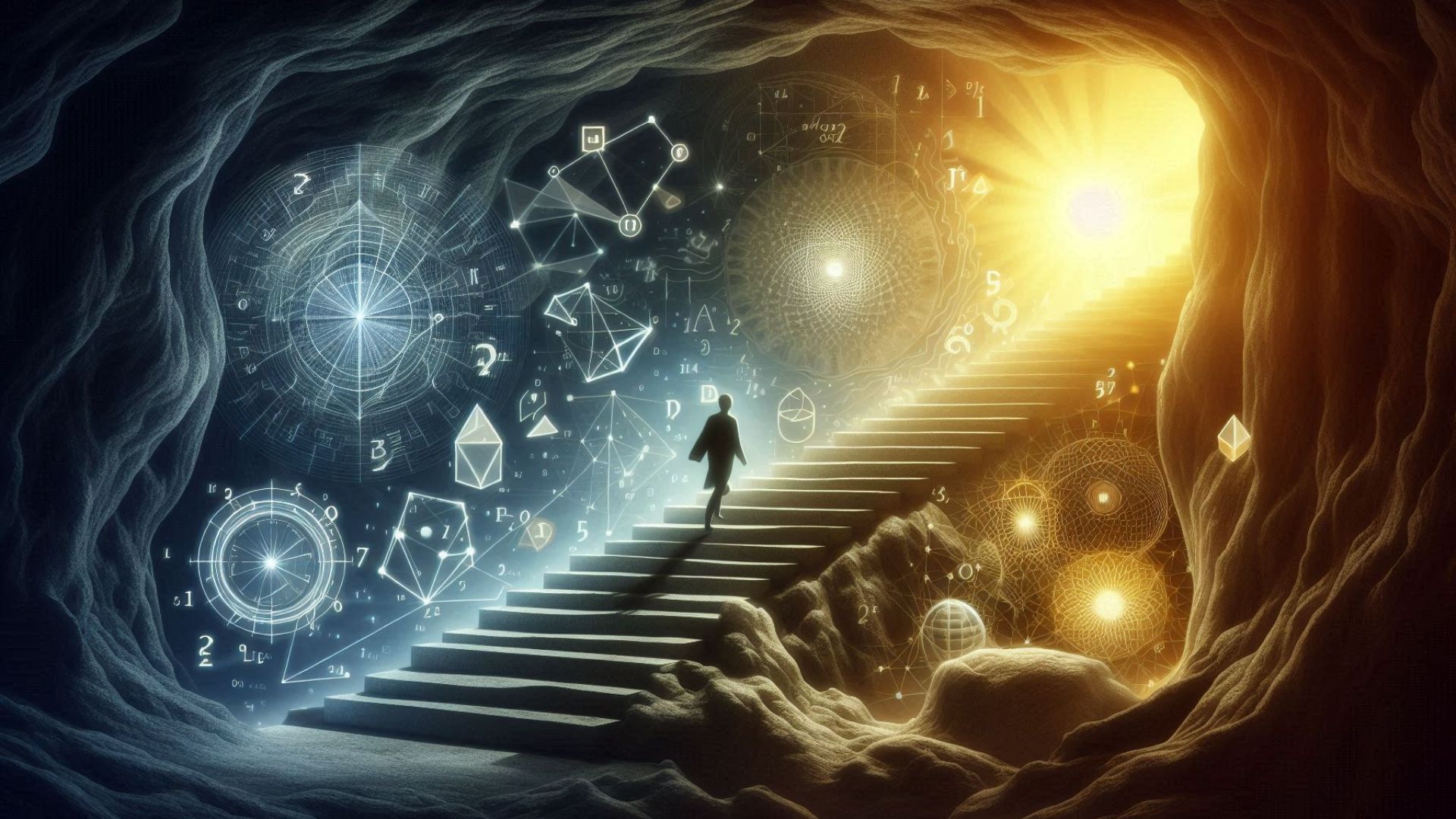
In the allegory, the inside of the cave represents the physical world we perceive through our senses. The shadows are the superficial projections of this physical world, not a true reflection of reality. Stepping out of the cave symbolizes the mind’s journey toward truth through philosophical thought and reasoning. For Plato, real knowledge is gained not through the senses, but through the intellect and philosophical inquiry.
Baudrillard, however, takes this narrative and repurposes it to build his own theory of simulation.
Baudrillard and the Theory of Simulation
As one of the most prominent figures in postmodern thought, Jean Baudrillard lays out how our perception of reality has shifted in his seminal work, Simulacra and Simulation (1981). He argues that modern society has lost the distinction between reality and its representation; instead, we live in an age where images and simulations have replaced reality entirely. Let’s dive into what that actually means.
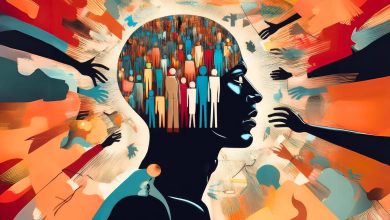
Baudrillard’s theory of simulation examines how our perception of reality in today’s world is manufactured by the media, pop culture, consumer society, and the capitalist system. He argues that what we see, hear, and experience is no longer a direct reflection of reality, but a simulation produced within “hyperreality.” Of course, social media didn’t exist when Baudrillard proposed this, but we’re certain that if he were writing today, he would argue this point even more fiercely. According to him, this simulation progresses through four stages.
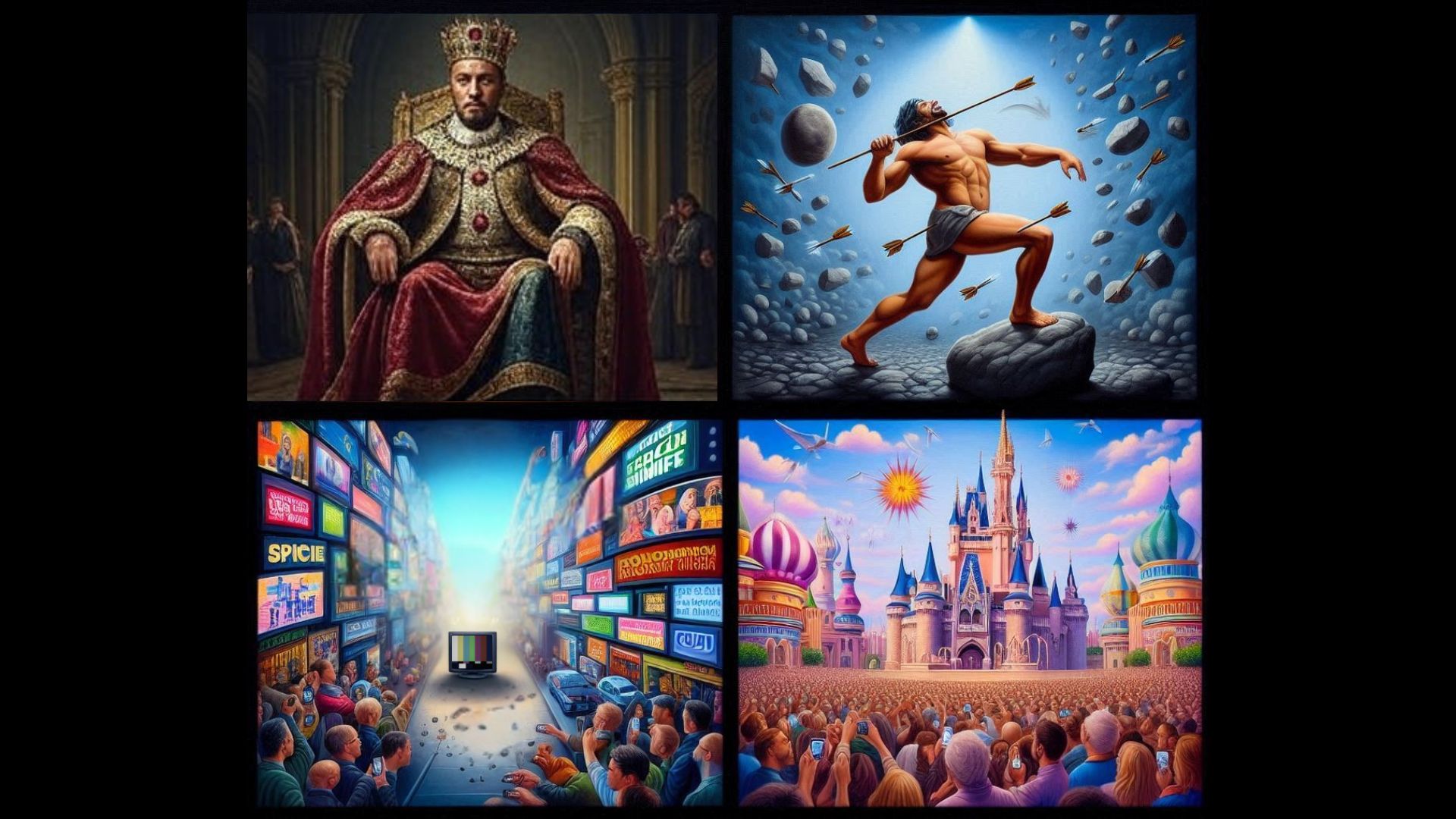
In the first stage (The Period of Representation), images are a direct reflection of reality. For example, a portrait of a king or a religious figure directly references their actual existence in the world. Reality is still the reference point, and the images are faithful copies. Portraits, nature paintings, photographs, and many other direct works fall into this category. In the second stage, the image is no longer a direct copy. If we think of it in terms of folklore, stories like Ferhat carving through mountains or Ulubatlı Hasan continuing to fight despite taking 50 arrows fall into this stage. Here, we see exaggeration and distortion.
In the third stage, reality begins to vanish entirely. This is where television commercials and news events that are intentionally distorted—where the truth is sacrificed for the sake of the image—come into play.
In the final stage, the simulation fully replaces reality. Baudrillard argues that this is most evident in the world today. Disneyland, TV shows, commercials, pop culture icons, and social media influencers have replaced the “real.” People live in a hyperreal world created by the media rather than in the actual world. Baudrillard focused heavily on Disneyland, arguing that it isn’t just an amusement park; it’s a simulation site designed to make the outside world seem “real.” The artificial world of Disneyland appears “fake” compared to the outside, but strangely, the outside world has become a part of the simulation, too. When people accept Disneyland as fake, they continue to believe their own lives are real—even though, according to Baudrillard, the outside world possesses the same level of artificiality.
The Cave and the Simulation
Perhaps the world we live in has transformed into a simulation even more complex than Plato’s cave. If we bring the modern world into the allegory, maybe breaking the chains is harder than ever. Is it truly possible to step outside, or has the simulation reached a point of no return, as Baudrillard suggested? Perhaps the only option is to keep questioning the shadows on the wall and the copies of the simulation… Because even if we cannot reach the truth itself, we can at least see what is standing in our way.
References and Further Reading
Baudrillard, J. (1999). Simulacra and simulations. In J. Wolfreys (Ed.), Literary theories: A reader and guide (pp. 381-394). Edinburgh University Press.
Baudrillard, J. (2017). Simülakrlar ve simülasyon (O. Adanır, Trans.). Doğu Batı Yayınları. https://d1wqtxts1xzle7.cloudfront.net/53420174/Jean_Baudrillard_-_Simulakrlar_ve_Simulasyon-libre.pdf?1496836692=&response-content-disposition=inline%3B+filename%3DSimulakrlar_ve_Simulasyon_Jean_Baudrilla.pdf
Macintosh, D. (2012). Plato: A theory of forms. Philosophy Now, 90. https://philosophynow.org/issues/90/Plato_A_Theory_of_Forms
The Autodidact’s Toolkit. (2024, August 21). Simulacra and simulation by Jean Baudrillard [Video]. YouTube. https://www.youtube.com/watch?v=g9CAbTf63NE
The Editors of Encyclopaedia Britannica. (2025, November 28). The Republic. Encyclopædia Britannica. https://www.britannica.com/topic/The-Republic
The Editors of Encyclopaedia Britannica. (n.d.). Myth of the cave. Encyclopædia Britannica. https://www.britannica.com/topic/myth-of-the-cave
The Living Philosophy. (2021, December 5). Do we live in a simulation? Baudrillard’s simulation and simulacra [Video]. YouTube. https://www.youtube.com/watch?v=ez362dgoODs
Originally published in Turkish at Doğa Filozofu.