


In philosophy, many famous thinkers become synonymous with the ideas they champion. For instance, even if it’s often misunderstood, we immediately associate Kant with the Categorical Imperative. Similarly, the mere mention of the World of Forms brings Plato to mind. In that same vein, unhappiness—a feeling and concept we all encounter far too often—is forever paired with its philosophical poster child: Arthur Schopenhauer. But was Schopenhauer truly such a miserable person, or does his narrative actually push us toward despair? Let’s dive in and try to understand Schopenhauer and his work.
A Brief Biography
Arthur Schopenhauer was born on February 22, 1788, in Danzig (modern-day Gdańsk, Poland) into a wealthy merchant family. His father, Heinrich Floris Schopenhauer, was a successful businessman who fully expected his son to follow in his footsteps. His mother, Johanna Schopenhauer, was a writer and a prominent member of the intellectual elite. Schopenhauer’s father provided him with an extensive education; travel across various European cities helped sharpen his linguistic skills and cultural breadth. By all accounts, Schopenhauer wasn’t exactly a ray of sunshine during these years. He is often described as a deeply pessimistic and difficult child.

In 1793, when he was five, the family moved to Hamburg. After his father’s sudden death in 1805 (which some sources suggest was a suicide), Schopenhauer began studying medicine and science at the University of Jena at his mother’s insistence. However, he wasn’t happy in these fields—which, let’s be honest, seemed to be his default state—and he decided to turn to philosophy. In 1809, he transferred to the University of Berlin, where he attended lectures by renowned philosophers like Johann Gottlieb Fichte and Friedrich Schleiermacher.
During his university years, Schopenhauer was profoundly influenced by the works of Immanuel Kant and the ideas of Plato. It was also during this time that he began to take an interest in Eastern thought systems, such as Indian philosophy and Buddhism. We’ll see exactly where he put those ideas to use in a moment.
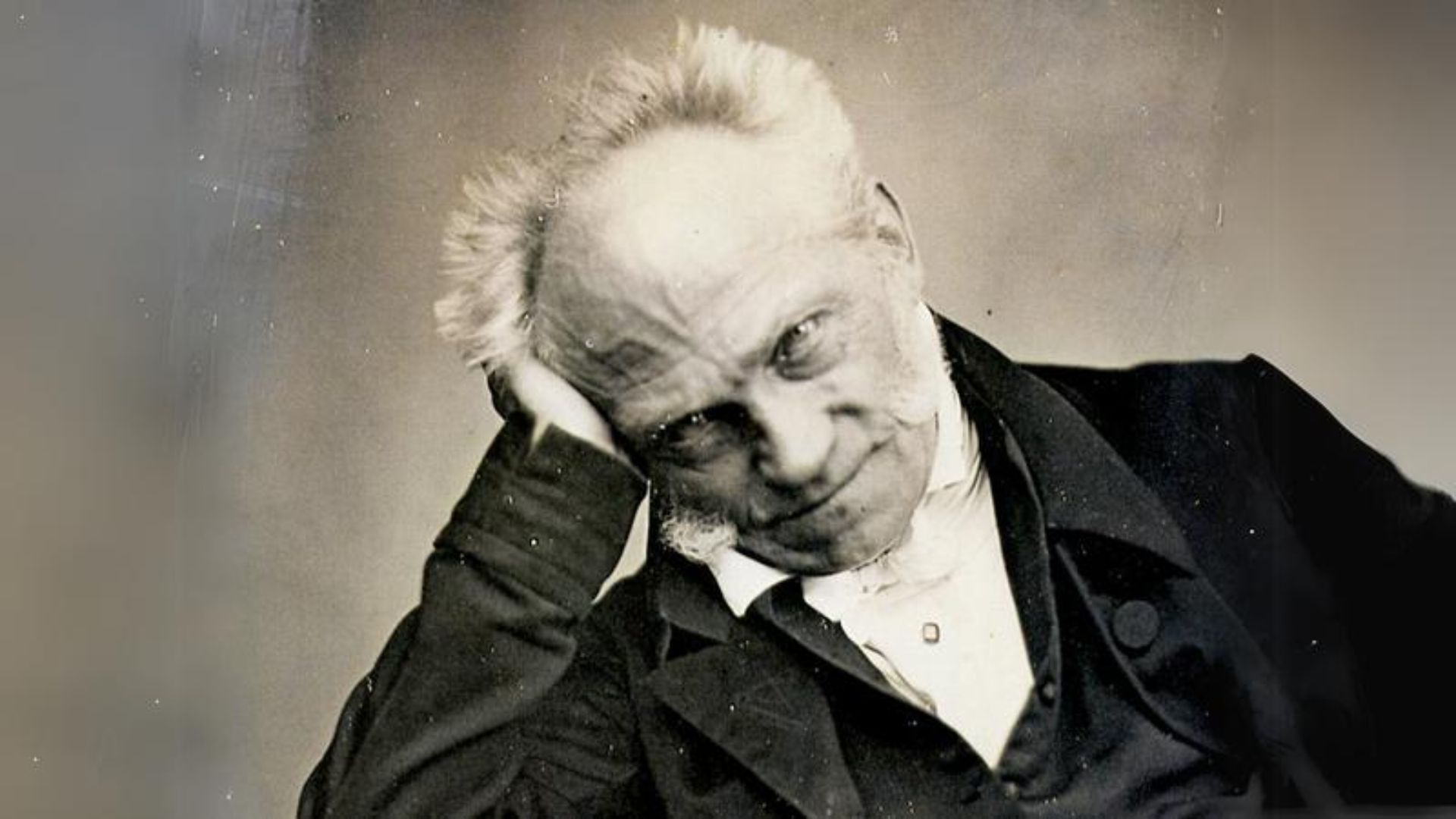
As he continued his philosophical career, he published his magnum opus in 1819: “Die Welt als Wille und Vorstellung” (The World as Will and Representation). Unfortunately, the book initially gained very little traction, leaving Schopenhauer deeply disappointed. This professional failure only hardened his bleak outlook on the world. But what was this book actually about?
The World as Will and Representation
First off, like Kant and Spinoza before him, Schopenhauer was hunting for the nature of reality. However, his goal was a bit different: he wanted to make life more understandable and, ultimately, more livable. Because he wasn’t happy in society and believed this unhappiness was baked into the human condition, he wanted to find a way to liberate us from it. So, what exactly are the “Will” and “Representation”?
For Schopenhauer, these concepts are a variation on Kant’s noumenon and phenomenon. We won’t get buried in the weeds here, but let’s briefly touch on Kant’s approach so we can see what Schopenhauer was building on.
Kant argued that it is impossible for us to know the essence of a thing in itself; we only know how that thing is transformed through our own perception. That “thing” has an essence, but it’s beyond our grasp. For example, according to Kant, we process a book through our own perception to understand it. It becomes meaningful to us, but if we were to completely remove our perception from the equation, we couldn’t explain what that book is in its pure essence. The book would still exist, but its existence would be unintelligible to us. Therefore, Kant felt that trying to explain the “essence” was a fool’s errand. In this framework, the noumenon is the book’s existence independent of us, while the phenomenon is its reflection in our minds. Schopenhauer, however, was obsessed with that essence and argued—contrary to Kant—that we could indeed illuminate the independent existence of things. He didn’t see the noumenon and phenomenon as two separate things, but rather as two sides of the same coin. In his terms, the phenomenon is Representation, and the noumenon is Will.
Let’s break down Will and Representation once more:
One of Schopenhauer’s foundational claims is that the world can be understood in two distinct ways. The first is the Will, and the second is Representation. The Will is the fundamental reality of the universe, while Representation is how that reality appears in an individual’s mind. In other words, while the world is governed by an irrational “Will,” it exists in our perception as a mental representation. Now, we all get the “representation” part—that’s just perception—but the “Will”? That’s a bit weirder, isn’t it? It’s about to get even weirder. If you’re satisfied with that definition and want to keep it simple, feel free to skip the next paragraph and head straight to the “Cause of Unhappiness” section.
For Schopenhauer, the “Will” is the driving force that causes things to exist. It’s almost as if the essence of being has a blind urge to exist. This is a deeply metaphysical idea, but it’s crucial to note that Schopenhauer does not mean a conscious, intentional desire. A rock does not “wish” to exist. This is a blind Will—there is no intellect or reasoning behind it. It is a metaphysical force that cannot be extinguished. To put it in a way that’s slightly simplified: you can think of it as a thing’s fundamental drive to be. The world itself is the product of this Will and Representation.
Schopenhauer uses the human experience to explain this relationship. Humans have both a physical and a mental existence. The body is an expression of the Will, while the mind perceives that body as a representation. This duality sits at the heart of Schopenhauer’s attempt to understand existence. For him, our experience of our own existence is simply the Will acting as a constant, driving force, and the mind representing that force.

This part might feel heavy, because Schopenhauer isn’t just some guy shouting about how sad life is; he has also baked an incredibly rigorous metaphysics into his philosophy. So, how do we summarize this difficult part?
Everything that exists is a product of the Will and Representation. The Will is the reason things (matter) exist. This is certainly not God for Schopenhauer, as he was an atheist. For him, the Will is the force that brings all matter into existence. You can think of it like the survival instinct found in living creatures. There is no logic or rational thought behind this Will. Now, let’s see where the unhappiness kicks in.
The Cause of Unhappiness
In this section, we’ll look at the “Unhappiness” narrative surrounding Schopenhauer from a slightly different angle and leave it to you to interpret the difference.
Schopenhauer argues that the Will we just described drives events in an irrational, non-intellectual way. Things happen around us beyond our control and in ways that are not always understandable by reason. However, our perceptions and thoughts—our “representation“—are rational. We act rationally and form expectations based on logic. Because of this, Schopenhauer argues that we do not have true free will and that we are living under an illusion. We think we can do whatever we want, but that’s a mirage. Our lives simply unfold within a chain of causality. Schopenhauer summarized this beautifully:
“Man can do what he wills, but he cannot will what he wills.”
Essentially, what we desire or what happens to us is driven by the irrational force of the Will. Because of this, free will doesn’t work the way we think it does. Interesting, right? We have the capacity to choose—we have reason—but those choices often lead to sorrow. Schopenhauer argues that since we live in an illusion and the source of our representation (reason) is what traps us, our own intellect becomes a barrier. Unlike other philosophers who champion reason, Schopenhauer sees it as a wall between us and reality, because our sense of control and the desires fueled by reason keep us from seeing the truth. Since we cannot control the Will or matter, Schopenhauer concludes that this world is fundamentally bad. In fact, it is so bad that we are trapped in a great contradiction, tossed about in a world we don’t control. It is precisely because of this that inevitable unhappiness permeates the world. So, can we escape it?
Not entirely. After all, for Schopenhauer, this is the worst of all possible worlds. At its core, it is governed by contradiction and disorder. Still, we might be able to be a little less unhappy.
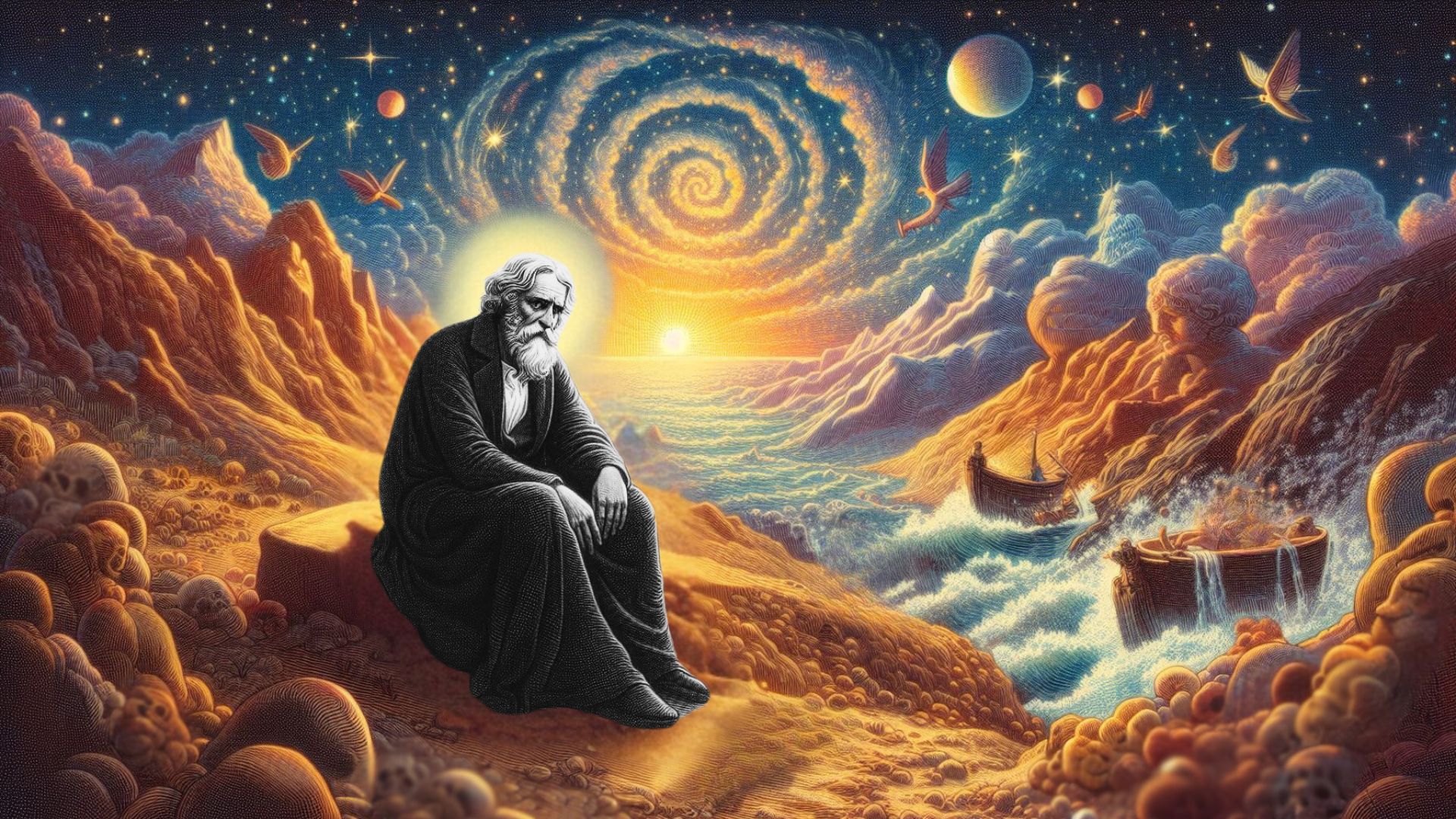
According to him, our desires are what push us toward unhappiness. Schopenhauer claims that the act of desiring is inherently meaningless, and therefore, we should minimize it. If we don’t, we create expectations, and since life isn’t under our control, we won’t get what we want, leading to disappointment. For instance, if you wish to be wealthy, you’ll likely face disappointment because you’ve made wealth a goal in a world you don’t control. But if you have no expectations, and the meaningless, random order of the world happens to drop wealth into your lap, you might be happy. Of course, for Schopenhauer, even that happiness is just a short-lived satisfaction. Still, reducing our desires acts as a shield against unhappiness. This is where that East Asian philosophy I mentioned earlier comes into play.
Another thing you might have heard about him is his hatred for women. Why is that? The answer is tied to the previous paragraph. Sex and love create desire in us. And because they create desire, suffering follows. Since sex and love cause such intense pain, Schopenhauer turned away from women and railed against them.
All of this is a rough sketch of his general outlook. Let’s not forget that, beyond all this, Schopenhauer also made significant contributions to art and politics. Yet, the views that brought him all his fame are his explanation of the universe and the form of existentialism he developed from it. We hope this article has been clear and insightful for you.
So, do you agree with his thoughts? Is the path to happiness truly found in detaching ourselves from desires? Looking at his own famously unhappy and difficult nature, one could say Schopenhauer wasn’t very good at practicing what he preached. We hope you have better luck finding happiness!
References and Further Reading
Arthur Schopenhauer (Stanford Encyclopedia of Philosophy). (2021, September 9). https://plato.stanford.edu/entries/schopenhauer/
Hübscher, A. (2024, November 22). Arthur Schopenhauer | German philosopher, pessimist &
The World as Will and Idea | work by Schopenhauer | Britannica. (n.d.). Encyclopedia Britannica. https://www.britannica.com/topic/The-World-as-Will-and-Idea
Writer. Encyclopedia Britannica. https://www.britannica.com/biography/Arthur-Schopenhauer
Originally published in Turkish at Doğa Filozofu.