
There’s a line we heard constantly from our philosophy teachers back in high school:
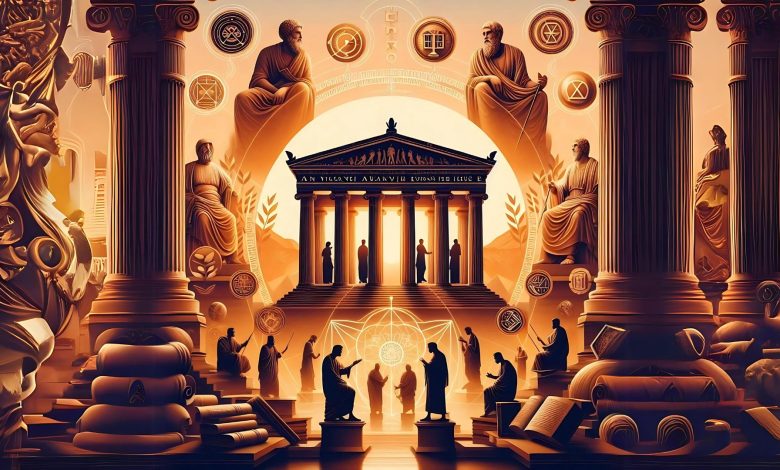
“Philosophy began in Ancient Greece.”
What is Philosophy?
While this isn’t strictly true, it’s easy to see why people say it. Philosophy didn’t just pop into existence in Ancient Greece out of nowhere. After all, philosophy isn’t an invention like the wheel, right? The word “philosophy” is essentially a combination of the Ancient Greek words “philo” and “sophia.” Sophia means wisdom, and philo means love—so, in short, we can call it the love of wisdom. Philosophy is an adventure set out to know, but here’s a spoiler for what comes next: Knowing isn’t actually that possible.
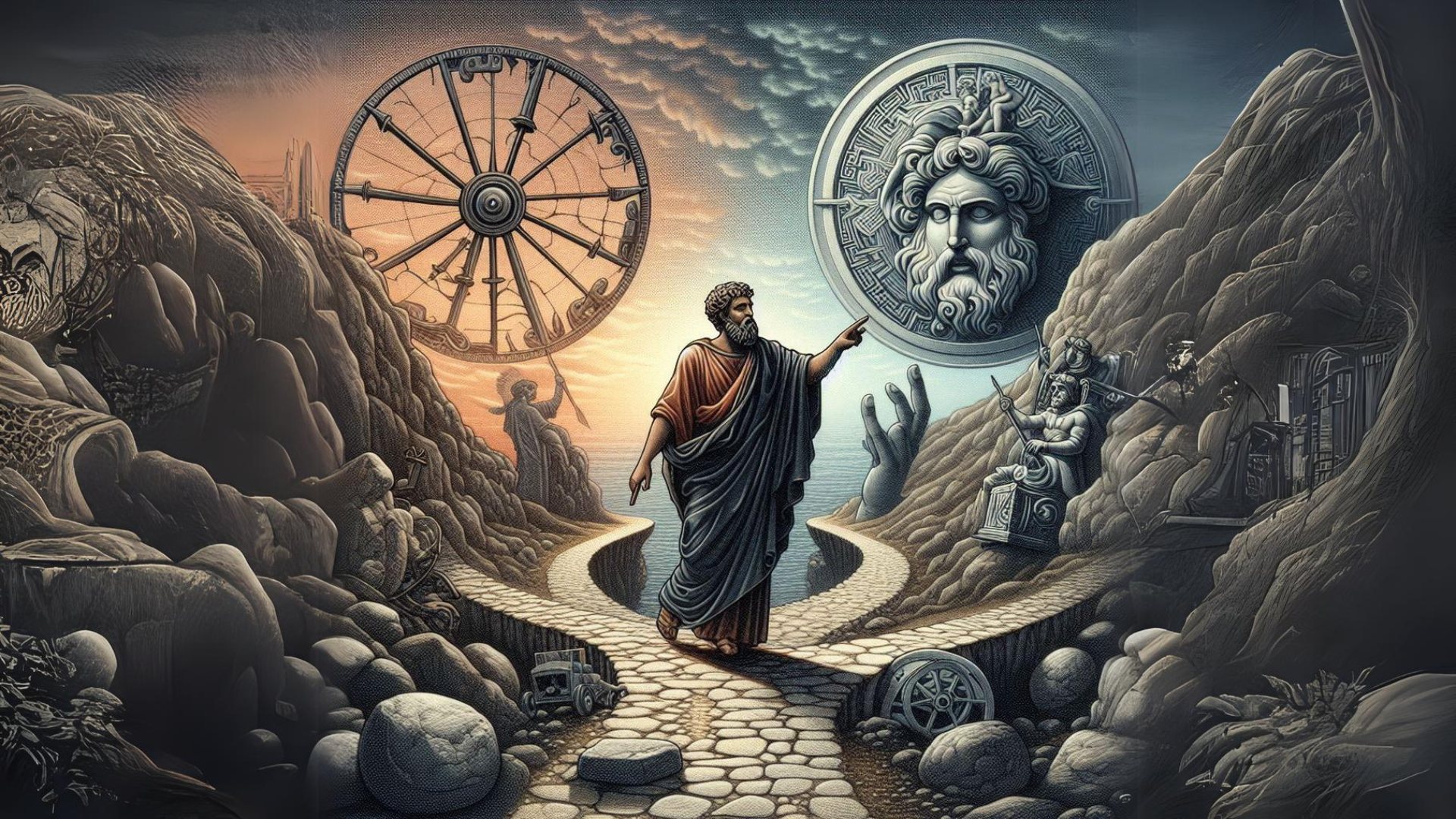
We can almost hear you asking, “What do you mean, dear author?” The heart of the matter is that in philosophy, the concepts of right and wrong are entirely up to you. At the end of the day, philosophy isn’t a hard science. If you say, “Water begins to boil at 120 degrees,” science can quickly correct you. You can’t make a claim about the sum of the interior angles of a triangle starting with “in my opinion.” Well, at least not if you want to be scientific. But when it comes to philosophy, all such claims bounce between right and wrong based on your own convictions.
You might also be saying, “Wait, we came here to read about Ancient Greek philosophy. What are you rambling about?” Unfortunately, philosophy is often misunderstood and seen as a boring… Wait, what should we call it? We can’t call it a science. And we can’t really call it a discipline, can we? Perhaps the most accurate term here is a “way of life.” This supposedly boring way of life is actually anything but. Now, let’s dive in together and take a look at the birth of philosophy as history knows it.

Philosophy started in many places simultaneously: Ancient Greece, Egypt, the Far East, and many others. Ultimately, anyone who strives to know and questions what they hear is, at their core, doing philosophy. Of course, the philosophy of someone trying to figure out which route to take is not the same as someone contemplating the ideal form of government or pondering the existence of God. And that is exactly why philosophy is born from questioning. To do this kind of questioning, you need to be a bit removed from the daily grind. After all, who has the time to ponder time, life, or ethics when they can’t even put food on the table for their children? It is precisely for this reason that the prosperous societies of Ancient Greece made such strides in philosophy. And the first great question that emerged was about our very essence.
The Problem of Essence
First off, to get through this article, we need to set aside our 21st-century mindset and travel back to well before the Common Era with a healthy dose of empathy. Back then, there was a belief that our existence—and indeed all existence—sprang from a single substance. But what was that substance? This substance, which they called the “arche,” was air for Anaximenes, water for Thales, and change itself for Heraclitus. This period predates the great philosophers everyone knows, like Socrates, Plato, and Aristotle. That’s why it’s called the “Pre-Socratic Period.” This era was defined by the debate over the arche, followed by a broader analysis of the universe. Anaximander went a bit further than his contemporaries, defining the arche as an infinite substance he called “apeiron.” This definition expanded the debate from a simple search for a substance into an effort to understand the universe itself. Around the same time, Heraclitus took things further by focusing on the theme of “change,” uttering those words we still hear so often today: “The only constant is change itself.” By doing so, he defined the arche as change. Ultimately, these ideas moved the discussion away from arguments like “The essence of the universe is fire” toward much deeper, abstract questions.

Following this, a new debate arose: Is the arche a single thing, or a mixture of several things? Philosophers like Anaxagoras and Empedocles argued that multiple substances created the essence, while Thales and Heraclitus defended the idea that a single arche was the source. As we mentioned, Heraclitus’s emphasis on change is an example of rooting existence in one thing. Of course, when we summarize these periods so quickly, the profound interpretations and nuances don’t fully shine through. Still, the fact that the debate moved from focusing on elements like fire, water, and air to incorporating concepts like infinity and change—and then asking whether the arche is one thing or many—is a testament to the richness of philosophy.
Ultimately, Pre-Socratic Ancient Greek philosophy focused primarily on these topics. For the curious minds among you, let’s quickly acknowledge the philosophers of the era:
- Thales: Considered the first philosopher. He proposed that the fundamental substance of the universe is water.
- Anaximander: Introduced the concept of “apeiron” (the infinite or boundless) as the origin of all things.
- Anaximenes: Suggested air as the fundamental substance of the universe.
- Heraclitus: Known for his doctrine of change, summarized by the phrase: “You cannot step into the same river twice.”
- Parmenides: Argued that reality is unchanging and that change is merely an illusion.
- Empedocles: Proposed the theory of the four root elements (earth, water, air, fire).
- Anaxagoras: Introduced the concept of “nous” (mind) as the ordering principle of the cosmos.
- Democritus: Developed the theory of atomism, suggesting that everything is composed of indivisible atoms.

Naturally, in an overview like this, we can’t give enough space to names like Democritus, who managed to propose the term “atom” way back then, but we have a surprise in the further reading section for those curious about his atomism.
Classical Greek Philosophy
This is where our three main figures take the stage: Socrates, Plato, and Aristotle. They were a chain of mentors and students. Aristotle was a student of Plato, and Plato was a student of Socrates. Consequently, their thoughts are deeply interconnected, and they each significantly refined the systems of their predecessors. Socrates is a bit different from the other two. He centered his life on the core philosophical value of questioning; he didn’t write anything down, and he had no interest in documenting his teachings. In that sense, he was a true orator who did all his work through conversation.
Socrates and His Philosophy
Socrates created an art of questioning that we call dialectics. What’s that like? Here’s a sample dialogue:
Merve: So, Hakan, do you find that girl attractive?
Hakan: My dear, I don’t find *any* girl attractive!
Merve: So you don’t find me attractive either?
Hakan: No, I think you’re wonderful.
Merve: Then am I not a girl?
Hakan: No, you’re a woman. Well, yes, you’re a girl.
Merve: So you do find girls attractive. Do I understand you correctly?
Hakan: I meant I don’t find any girl attractive *except* for you.
We’re being a bit cheeky here, but let’s explain the trick. Merve is actually doing what Socrates did. She threw out a question, and Hakan, like an innocent Ancient Greek citizen, answered without thinking. Then, Socrates would start asking other questions that would cause the initial statement to crumble. Then again, and again… until the final sentence had nothing to do with the original answer. Of course, Socrates didn’t ask silly questions like that; he asked complex questions about everything from the ideal form of government to how to live a good life. The goal of these questions was to reach the most reasonable and accurate answer together through conversation. That is the dialectic method.

Beyond that, Socrates was in absolute pursuit of knowledge. He believed that “virtue,” a concept of paramount importance to the Ancient Greeks, could only be attained through knowledge. He viewed the wicked as being distant from virtue—that is, distant from knowledge. This created a stubborn path for Socrates. In his pursuit of knowledge, he constantly questioned death, the soul, and ethical values.
It is for this reason that Socrates began questioning the traditions of Ancient Greece, criticizing the rules he found nonsensical. That led to his trial and his famous defense. Unfortunately, that defense didn’t save Socrates, but he didn’t really have any intention of being saved, either. (Those interested in this can check out the resource on the *Crito* dialogue in the further reading section.)
After Socrates came his student, Plato, who really shook things up. He questioned things that hadn’t been questioned before, and he provided answers to old questions that changed the very nature of the debate. How did he do it? Let’s take a look.
Plato and His Philosophy
Plato introduced the Theory of Forms (or Ideas). So, what is this theory?
According to this theory, everything we see in the material world has a perfect and unchanging form in the world of Ideas. In other words, there are two worlds. The first is the world we see and perceive; the second is the world of Ideas, where their true versions exist. It’s hard to explain clearly, but let’s try:
Imagine you are a child, dreaming of your favorite cake. This cake is so perfect, exactly how you want it. Now, think about this cake in your imagination:
Let’s say the cake of your dreams is frosted with the most beautiful icing and tastes absolutely divine. That is the ideal cake you’ve conjured in your mind.

Now, you want to make this cake, so you head to the kitchen and try to bake a real one. You mix the ingredients, bake it, and decorate it, but even if the cake turns out delicious, it’s never as perfect as the one in your dreams. Maybe the frosting dripped a bit, or the taste isn’t quite right. That is exactly the situation with the world of Ideas. Every object in our world is flawed. For instance, a table can break, its color can be ugly, it can rot—but the table in the world of Ideas doesn’t experience these things. It possesses whatever its most essential qualities are. Don’t think of the world of Ideas as just the “ideal” version in your head. The point is that the real world is a reflection of the world of Ideas. Plato says that every object or concept exists in its cleanest and most perfect state in the world of Ideas. That’s the essence of it. Be proud of yourself! You’ve just learned one of the most important concepts in the history of philosophy! But hang in there, let’s keep going, shall we?
After passing this great exam on Plato, we’ll leave him behind for this article, but don’t forget: we’ve only scratched the surface. What lies beneath? No matter, let’s continue with his successor, Aristotle.
Aristotle and His Philosophy
Aristotle examined existence in every detail and believed there were 4 main causes of being:
- Material Cause: What something is made of.
- Formal Cause: The shape or essence of something.
- Final Cause: The purpose or intention of something.
- Efficient Cause: Why or how something changes.
Okay, but what does this mean? Let’s use a simpler example, just like we did with the world of Ideas:
Think of a toy car. It has its “what it’s made of” (plastic), its “shape” (car shape), its “purpose” (to be played with as a toy), and its “how it was made” (in a factory). For Aristotle, an entity exists only through the answers to all these questions. If you think about it, he’s not entirely wrong. If we can’t define these traits for an object, it doesn’t really have a place in our minds, does it?
If you can bear with us, can we say one last thing about him? Aristotle built upon the theory of the world of Ideas using these four causes, adding to that system. We’ll save the rest of this for another time, and you can see his ethical understanding in our previous article, “If You’re Unhappy, You’re Immoral: Virtue Ethics.”
Now, before moving to the post-Socratic period, let’s briefly explain Aristotle’s logic. Aristotle created a structure that encodes correct thinking, which is the foundation of the science of logic. For example, if we say “All dogs bark” and “This animal is a dog,” then we can say this animal barks. That’s it! We’ve grasped Aristotle!
Hellenistic Philosophy
We’ve reached the final topic of this article! We’ll keep this part quite brief. We’re all tired, and our minds need a rest.
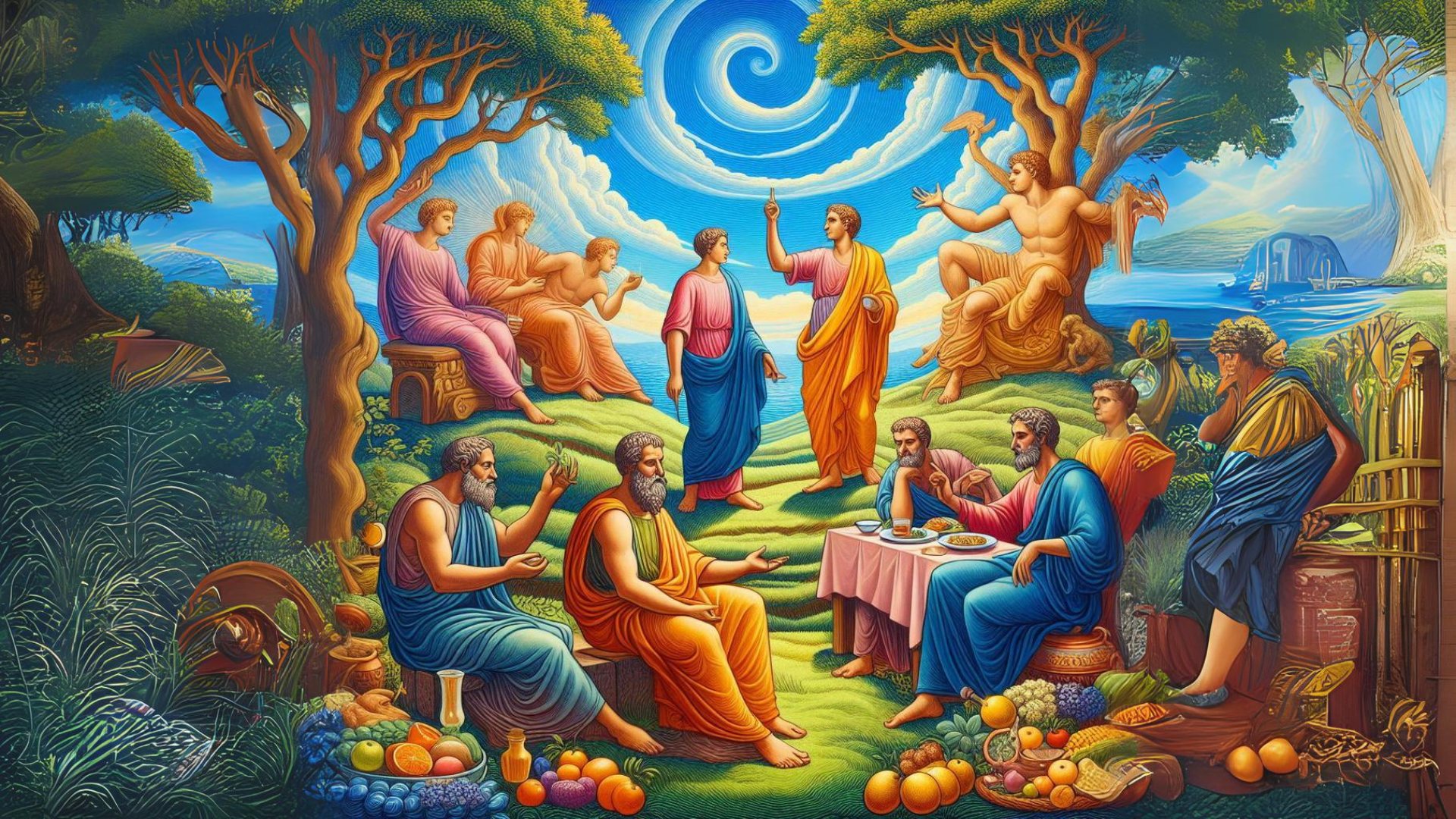
This period stands out more for the systems and ideologies it produced than for its individual philosophers. Many topics regarding knowledge, politics, and living a good life remained on the agenda during this time. Although grand arguments were made, our focus—at least for this article—will be on the approaches that emerged in the wake of these arguments.
Stoicism

In Stoicism, widely considered to have been founded by Zeno, the focus is on remaining calm and strong even when bad things happen. For example, a child who loses their toy shouldn’t be overly upset but should instead try to understand that this is part of nature and maintain self-control. In essence, it’s an approach that keeps one away from rebellion and suffering, requiring the acceptance of things as they are. Though often confused with fatalism, Stoics don’t directly attribute these events to fate. Since their goal is to remain strong, calling them fatalists isn’t quite accurate. Marcus Aurelius, whose name many know today, carried this philosophy.
Epicureanism
Epicureans preferred living a simple life rather than one of luxury and ostentation. To reach happiness, they sought to stay away from pain, and they believed that discussing or dwelling on concepts like death was pointless. Of course, don’t think of them as indifferent people; Epicureans simply believed that focusing on emotions like pain was unproductive.
Skepticism
We’ve reached the last concept of the day, but it’s the one that has held the biggest place in the history of philosophy! Skeptics argued that certain knowledge is impossible and suggested constant skepticism. This allowed individuals to lead a calm and peaceful life. For example, if you asked a skeptic about the existence of God, they would tell you that they could never know the answer and that they were equally distant from both sides—essentially, they were what we might call agnostics.

When we leave all these concepts behind, we’ve essentially left Ancient Greece behind as well. Of course, such a long and comprehensive period cannot be fully told in a 2,000-word article, but we’ve covered its highlights with great pleasure. See you in the next articles of our series!
References and Further Reading
Crito | work by Plato. (n.d.). Encyclopedia Britannica. https://www.britannica.com/topic/Crito
Kenny, A. J., & Amadio, A. H. (2024, September 10). Aristotle | Biography, Works, Quotes, Philosophy, Ethics, & Facts. Encyclopedia Britannica. https://www.britannica.com/biography/Aristotle
Kraut, R. (2024, September 10). Socrates | Biography, Philosophy, Method, Death, & Facts. Encyclopedia Britannica. https://www.britannica.com/biography/Socrates
McLellan, D. T., Levi, A. W., Wolin, R., Maurer, A., Chambre, H., Von Fritz, K., & Stroll, A. (2024, August 9). Western philosophy | History, Figures, Schools, Movements, Books, Beliefs, & Facts. Encyclopedia Britannica. https://www.britannica.com/topic/Western-philosophy/Hellenistic-and-Roman-philosophy
Meinwald, C. C. (2024, September 23). Plato | Life, Philosophy, & Works. Encyclopedia Britannica. https://www.britannica.com/biography/Plato
Plato (Stanford Encyclopedia of Philosophy). (2022, February 12). https://plato.stanford.edu/entries/plato/
Von Fritz, K. (2024, August 21). Greek philosophy | Definition, History, Pre-Socratics, Socrates, Plato, Aristotle, Stoicism, Epicureanism, & Facts. Encyclopedia Britannica. https://www.britannica.com/topic/Greek-philosophy
Von Fritz, K., Maurer, A., Wolin, R., McLellan, D. T., Stroll, A., Chambre, H., & Levi, A. W. (2024, August 9). Western philosophy | History, Figures, Schools, Movements, Books, Beliefs, & Facts. Encyclopedia Britannica. https://www.britannica.com/topic/Western-philosophy/Ancient-Greek-and-Roman-philosophy
Originally published in Turkish at Doğa Filozofu.