

Have you ever stopped to wonder what actually makes an idea “scientific”? Is it that everyone agrees on it? Is it that it’s observable? Or is it perhaps the very possibility that it could be proven wrong? What ground does the knowledge we accept as “true” today actually stand on? Karl Popper was a philosopher who spent his life chasing these exact questions. In this piece, we’re going to look not just at the theories of a philosopher of science, but at a mental revolution that fundamentally changed how we think.
Who Was Popper?
Life often starts with a question, doesn’t it? For Karl Popper, one of those questions was: “What makes an idea scientific?”
Born in Vienna in 1902, Popper was deeply immersed in both art and philosophy from a young age. He had a passion for music, an interest in mathematics, and he wasn’t afraid to flirt with socialist ideals. But Popper learned something just as important as how to embrace ideas: he learned how to doubt them.
Although he moved in Marxist circles in his youth, he soon became uncomfortable with the way the system seemed impossible to falsify. Every explanation had a built-in answer, but those answers were never actually tested. This state of questioning laid the foundation for the intellectual stance he would hold for the rest of his life: “True knowledge is only valuable as long as it is refutable.”
So, what was Popper really getting at? How could knowledge be refuted? The answer lies in the concept he is most deeply identified with: the Principle of Falsifiability.
The Principle of Falsifiability
As Popper tried to grasp the essence of science, he turned the era’s understanding of it upside down. He challenged the positivists’ principle of “verification through observation” and introduced a brand-new criterion: the principle of falsifiability. According to him, if a theory claims to explain everything, that’s a sign it’s based on faith, not science. For example, if a field like astrology—which is supposedly about celestial events—claims to also influence your psychological choices, it ceases to be science and becomes belief. To Popper, a real scientific theory must be different: it must take risks and remain open to being proven wrong.
This was a radical departure, because before Popper, the scientific world was ruled by another concept: verificationism.
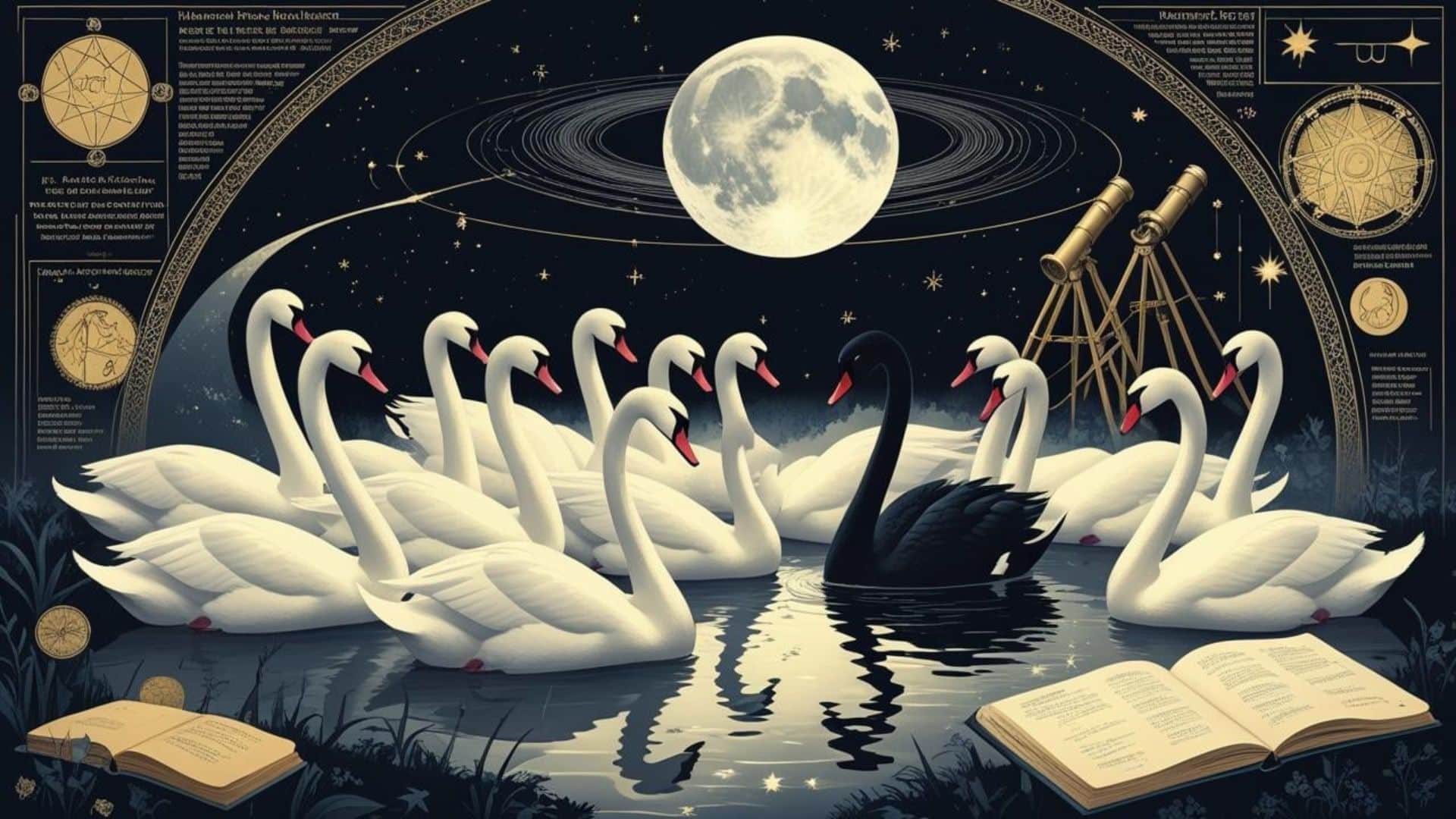
This approach argued that the more a hypothesis was supported by confirming examples, the more scientific it was. Popper rejected this outright. To him, no chain of observations can ever lead to absolute truth because there is always another possibility lurking. A single black swan, after all, instantly refutes the claim that “all swans are white.” This is where Popper set his benchmark for a scientific theory: “A proposition can only be scientific if one can imagine an observation or experiment that would refute it.”
The best example of this comes from Popper himself: the claim that “all swans are white” isn’t proven by a thousand white swans; it is refuted by a single black one. For Popper, this is how science progresses: through a fallible but open-minded process. So, how do we see this in practice? Let’s look at Einstein.
Einstein predicted that light would bend in a gravitational field. During Popper’s time, an opportunity to test this arose. Measurements taken during the solar eclipse of 1919 confirmed the prediction. The light did bend—but if the measurements had come out differently, Einstein’s theory would have been falsified. To Popper, this risk of failure is exactly what proves a theory is scientific.
Popper’s contribution to the world of thought didn’t stop there. He also took a keen interest in history, which led him to critique the concept of historicism.
Historicism and Open Societies
Before we dive into Popper’s take, let’s make sure we understand what he was critiquing. Traditionally, historicism argues that historical events develop in a specific direction, in a gradual and inevitable way. Thinkers like Hegel and Marx championed this. While it might sound like a solid explanation at first, if you think about it, they were claiming that history unfolds according to scientific laws. Popper pushed back hard against this. He argued that these views create the illusion that we can know the future. Popper explained it like this: “The future of science and society depends on theories not yet invented, facts not yet discovered, and decisions not yet made. Therefore, it is impossible to predict.”
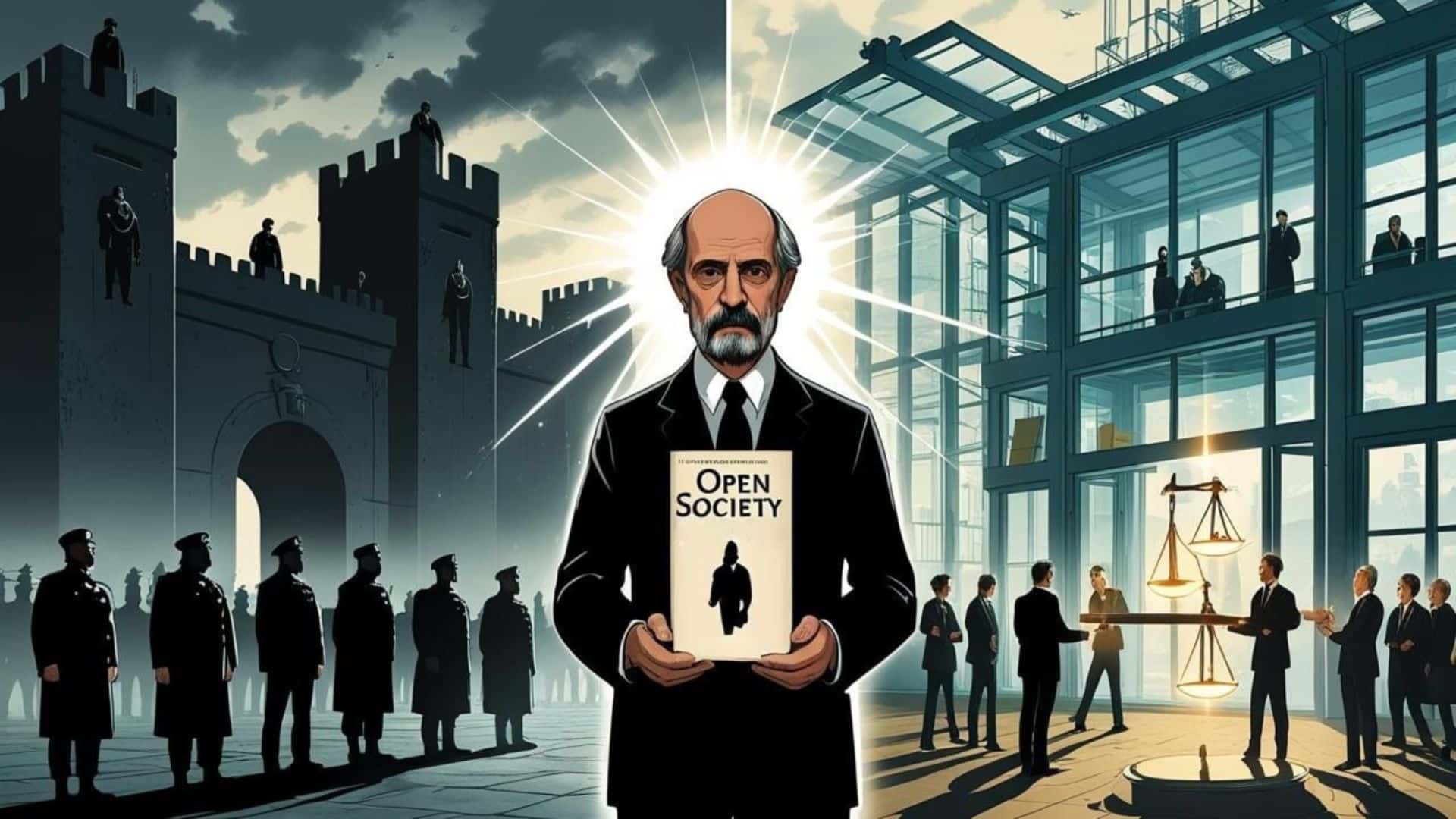
So, Popper criticized historicism both because it couldn’t be falsified and because it relied on prophecy. He took it a step further, arguing that historicism wasn’t just a philosophical error—it was a way of thinking that provided legitimacy to authoritarianism and totalitarian regimes. We can hear you asking, “What does that have to do with anything?” Popper explained that those who believe in the “laws of history” can justify suppressing individuals who don’t serve those laws. Furthermore, anyone claiming to “know” the future inevitably turns into an unquestionable authority. Popper was dead set against this. In his 1945 work, *The Open Society and Its Enemies*, he examined this from both a philosophical and political perspective. The book serves as a philosophical defense of liberal democracy and highlights the “closed society” ideologies that threaten it. In short, an open society is one where individuals are free and democracy prevails, while closed societies are those ruled by rigid, often authoritarian structures. To Popper, thinkers like Plato, Hegel, and Marx were enemies of the open society. Why? Because Plato idealized a closed, hierarchical society in *The Republic*; Hegel sanctified the state as “the march of God on earth”; and Marx viewed class conflict as an inevitable, deterministic force.
With these ideas, Popper sent shockwaves through the world of philosophy. When he passed away in 1994, he left behind more than just books; he left behind a way of keeping thought alive. For him, the intention to keep moving toward the truth was more important than actually reaching it. Every time we ask a question, every time we approach a dogma with skepticism, and every time we have the courage to try and refute an idea, we are doing the work of philosophy—and in the light of falsifiability, every idea continues to grow.
References and Further Reading
The Editors of Encyclopaedia Britannica. (n.d.). Karl Popper. Encyclopedia Britannica. https://www.britannica.com/biography/Karl-Popper
Thornton, S. (2022, September 12). Karl Popper. The Stanford Encyclopedia of Philosophy. https://plato.stanford.edu/entries/popper/
Originally published in Turkish at Doğa Filozofu.