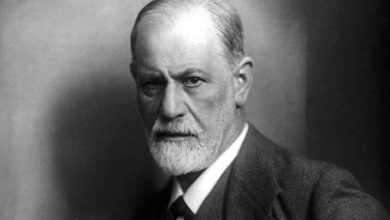


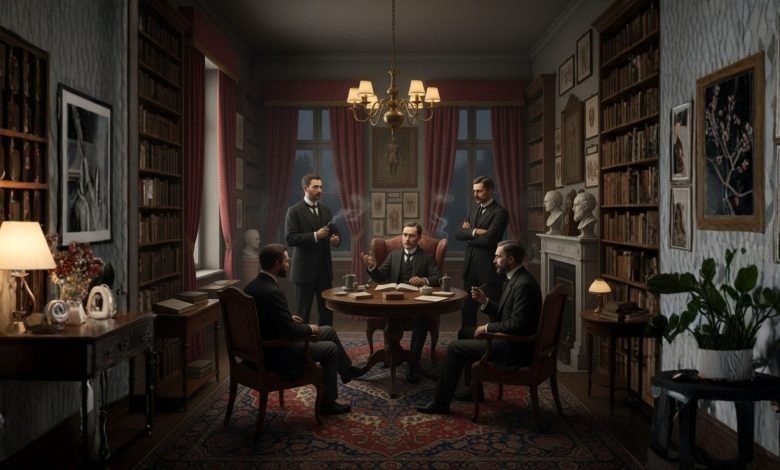
“A revolution can sometimes begin in a small room.”
This sentiment feels tailor-made for the Wednesday Psychological Society, which kicked off in the modest Vienna living room of the brilliant psychoanalyst Sigmund Freud. But that living room was more than just a nursery for a new science; it was a stage for the clash of ideas, the forging and breaking of alliances, and the storms that swirled around a genius. This first psychoanalytic circle wasn’t just the birthplace of a scientific breakthrough—it was the epicenter of an intellectual drama.
“The Need for Community”
Sigmund Freud is one of the most provocative and transformative figures of the 20th century. But he wasn’t just a lone genius; he was a leader who stood at the heart of an intellectual community, building a systematic movement of thought around him. The first organized iteration of this movement was the Wednesday Psychological Society—a small but potent group that began meeting in Freud’s Vienna home in 1902. Over time, the group expanded and morphed into the Vienna Psychoanalytic Society, but the very ideas that made Freud a sensation would eventually tear the structure apart.
Freud’s Vienna Years and First Steps
Freud’s childhood and youth were shaped by poverty and the social realities of antisemitism. Growing up in the Leopoldstadt ghetto of Vienna (a district defined by its economic and social marginalization), Freud was immersed in a rigorous intellectual environment from an early age. During his university years, he fell under the influence of the Helmholtz School and spent time in neurology. However, his real turning points were his interactions with Jean-Martin Charcot and Josef Breuer. These experiences pushed Freud toward the study of the unconscious and hysteria.
The Birth of the Wednesday Society
In 1902, Freud invited doctors like Max Kahane, Rudolf Reitler, Wilhelm Stekel, and Alfred Adler to his home every Wednesday evening. As these meetings became more systematic, they functioned as a laboratory for Freud’s developing theories. It was here that revolutionary concepts like “free association,” the “interpretation of dreams,” and “unconscious processes” were put to the test.
According to observations by Sadger, these meetings were as much a showcase for Freud’s rhetoric and leadership as they were for the brilliance of his ideas. Sadger described Freud’s presentations as “spellbinding” and “unforgettable,” while also noting his uncanny ability to “silence everyone with a single sentence.”
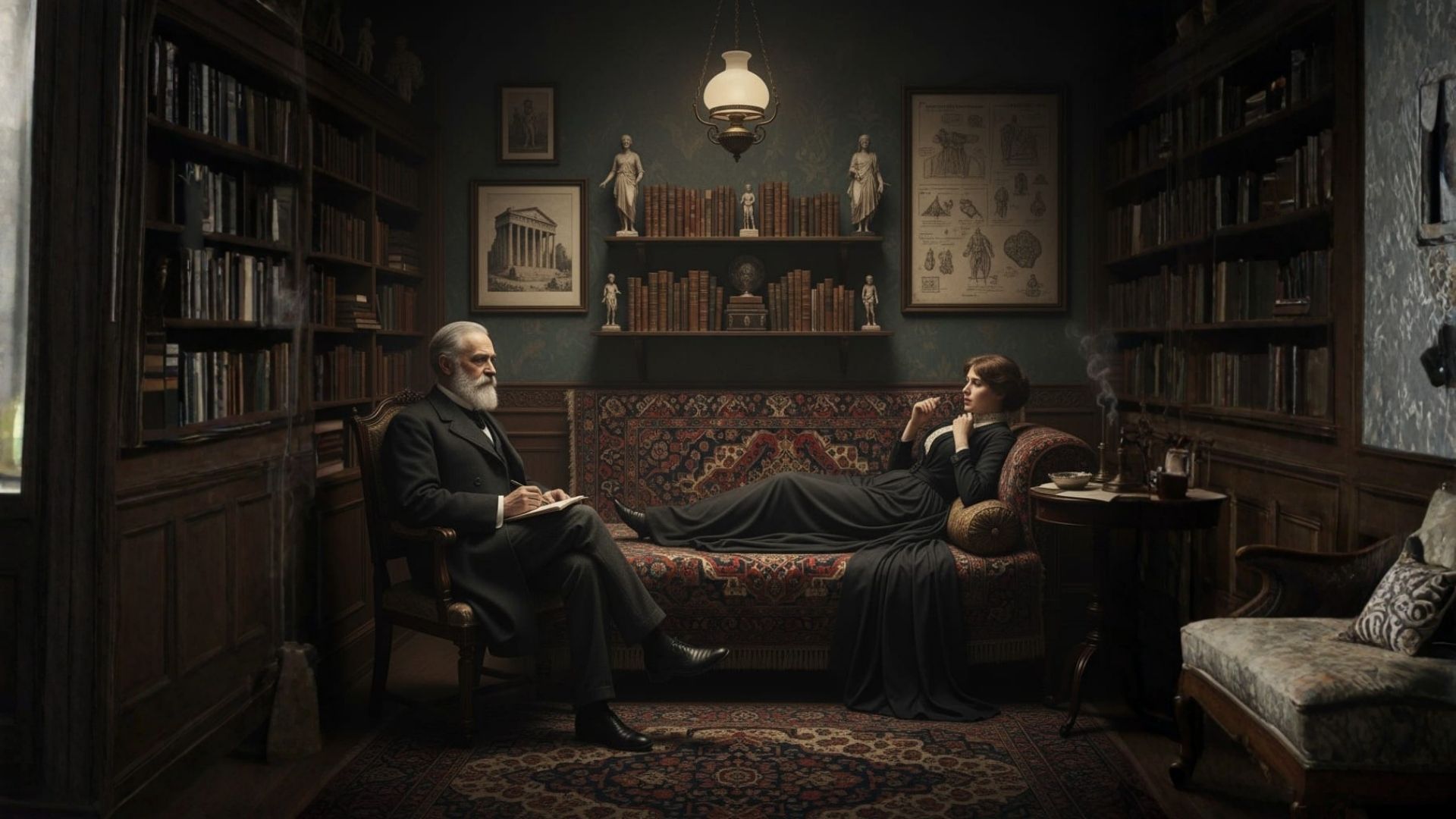
In 1902, Sigmund Freud began inviting a few colleagues to his home every Wednesday night to share his theories on the depths of the human mind. The original members included Wilhelm Stekel, Alfred Adler, Max Kahane, and Rudolf Reitler. The group was known as the Psychologische Mittwochsgesellschaft, or the “Wednesday Psychological Society.”
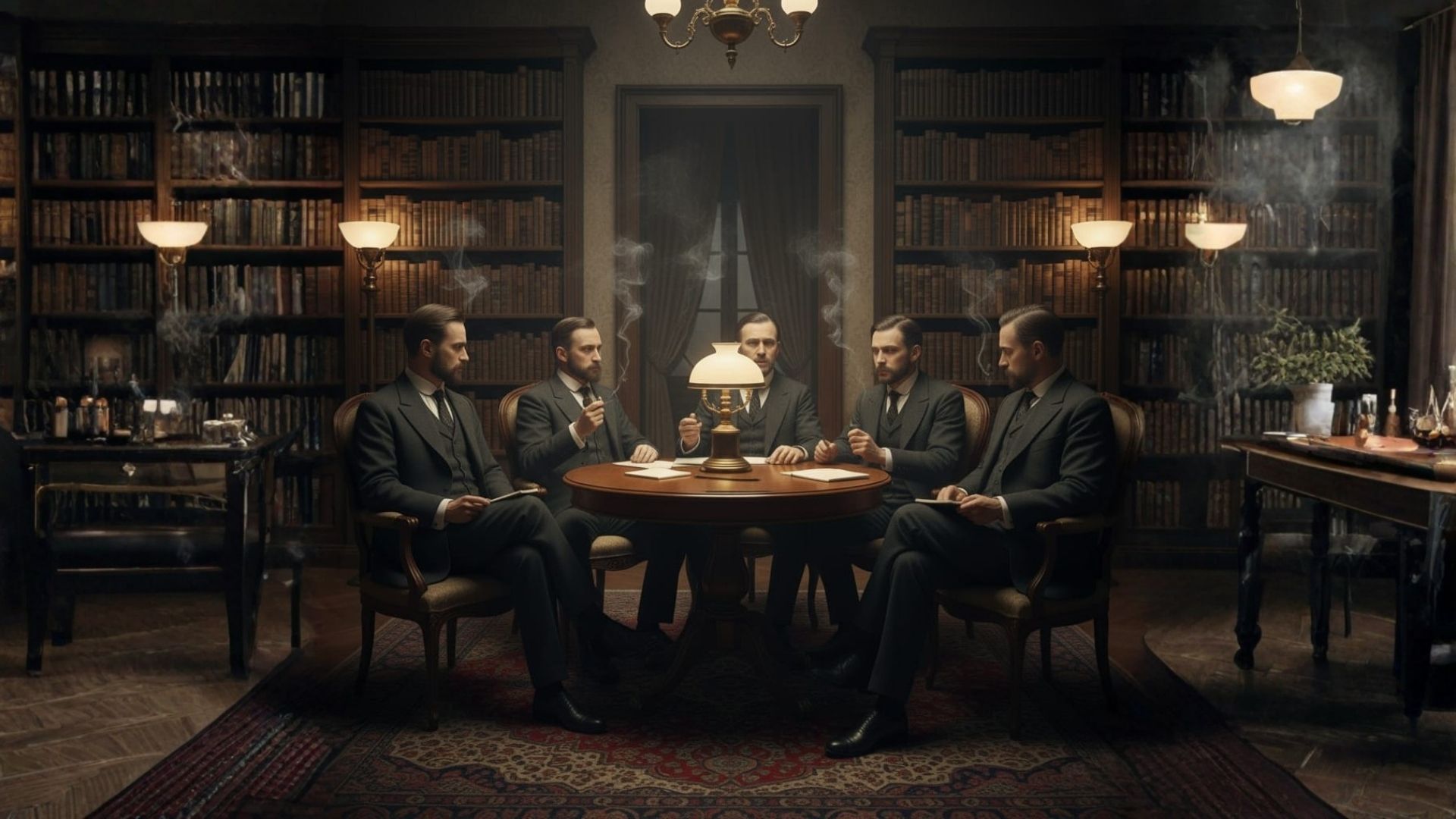 Image generated with the help of AI.
These gatherings started in a friendly atmosphere; Freud shared his ideas, members debated, and notes were taken. But as attendance grew and perspectives diversified, the discussions began to sharpen.
Freud’s theories on infantile sexuality, repressed drives, and the Oedipus complex were viewed by some members as controversial and out of step with the scientific consensus of the time.
Freud’s Rise and the Shift to a Power Center
Freud’s leadership wasn’t limited to producing scientific ideas; he also directed the group’s structure and membership. According to Sadger, Freud expected constant admiration and would adopt a distant, cold demeanor when he felt he wasn’t receiving it.
When Carl Jung was appointed head of the International Psychoanalytical Association (IPA) in 1910, it signaled that Freud’s theories were being institutionalized on a global scale. But it also highlighted Freud’s desire to remain the “central power.”
The Tensions Begin: Loyalty or Freedom?
As the community grew and members from different countries joined, disagreements became inevitable. Freud’s insistence on his core theories—the unconscious, infantile sexuality, and the Oedipus complex—began to grate on figures like Alfred Adler and Carl Jung.
By several accounts, Freud’s leadership evolved into a rigid form of centralism where dissent was rarely tolerated. Some witnesses described his response to criticism as “coercive” or “authoritarian.”
Sensational Breakups: The Departure of Adler and Jung
In 1911, Adler left the group, arguing that Freud’s theories were overly focused on sexuality, and went on to found his own school of “Individual Psychology.” Adler felt that Freud ignored the influence of class and social factors. This split shook Freud both scientifically and emotionally.
In 1913, there was a dramatic break with Carl Jung. Jung believed that Freud was limiting psychoanalysis to a “Jewish science” and emphasized the collective aspects of the unconscious. For Freud, Jung’s departure felt like a personal betrayal. According to Sadger, Freud initially showered Jung with special attention, only to openly humiliate him once their differences became irreconcilable.
Freud’s Emissaries: Expansion and Division
Freud’s views quickly spread to Germany, France, Switzerland, Hungary, and even America. Figures like Ernest Jones (England), Sándor Ferenczi (Hungary), and Karl Abraham (Berlin) became the champions of his ideas in their respective countries.
However, local cultural influences and different interpretations added new layers to Freud’s “pure” psychoanalysis, leading to further ideological rifts. For example, while Ernest Jones remained one of Freud’s most loyal students, Jung drifted toward a more spiritual direction.
For Freud, these divisions were deeply personal and scientific setbacks. He had parted ways with his closest confidants, but psychoanalysis was no longer just the idea of one man—it had become a movement.
Freud’s View of the Community: Between Love and Hate
Sadger notes that Freud would initially praise new members, only to eventually turn critical and demanding. Some sources emphasize that Freud was perpetually anxious about his theories being reinterpreted by others.
Freud’s deepest fear was that his ideas would be “rediscovered” by someone else. As a result, it is said that he tried to prevent anyone else from claiming a new discovery.
Freud’s Final Position: The Loneliness of Genius
In his later years, as Freud battled illness, war, and the rise of fascism, the psychoanalytic structure he built continued on its own path. Having severed ties with many of his students due to his authoritarian streak, Freud had, in a sense, become a victim of his own ideas. Yet, despite it all, he maintained his historical place as the founding father of psychoanalysis.
Scientific Interpretations and Academic Assessment
A 1997 study by researchers Elke Mühlleitner and Johannes Reichmayr examines the Wednesday Society as a sociological structure. They argue that the group was “semi-hierarchical” and that opposing Freud’s ideas could lead directly to exclusion. This structure can also be explained through Thomas Kuhn’s theory of “scientific revolutions”: A true revolution in science doesn’t just start with a new idea, but with the resistance of a courageous group defending that idea. Freud’s circle was exactly that kind of resistance group.
Freud’s Sensational Ideas
Freud’s core claim was this: Human behavior is determined by unconscious processes and repressed sexual drives. This was a massive affront to the moral and scientific norms of the day. According to Freud, the roots of neurosis were almost always found in childhood trauma and sexual repression.
These thoughts caused his rift with names like Alfred Adler and Carl Gustav Jung. While Adler focused on the individual’s social environment and the drive for superiority, Jung argued for a collective nature of the unconscious and found Freud’s sex-centric approach too restrictive.
As a result, in 1911, Adler left to form his “Individual Psychology” school. In 1913, Jung broke away to start the school of “Analytical Psychology.”
A Social Experiment Within Science
Psychoanalysis was not just a new psychological theory; it was an experiment in intellectual community. The circle that formed around Freud didn’t grow through consensus, but through conflict.
Interestingly, Freud never turned the Wednesday Society into a democratic structure. This eventually led to his leadership being questioned. When the group officially became the Vienna Psychoanalytic Society in 1908, written applications and selection criteria were introduced. For many, this triggered feelings of exclusion or alienation.
Max Graf described this transition in his memoirs:
“We were once a circle of friends, but now we are expected to undergo a kind of ritualized discipline. It is no longer intimate.”
Communities Make Revolutions, Revolutions Bring Breakups
Freud’s Wednesday Society was an experiment not just in a scientific movement, but in the nature of human behavior and intellectual leadership.
The way Freud defended his sensational ideas was just as influential as the ideas themselves—it either transformed those around him or pushed them away. The revolution that started on Wednesday evenings in Freud’s living room eventually became a crossroads where everyone eventually went their separate ways.
The Wednesday Society is one of the most fascinating and complex intellectual groups in the history of psychology. Even though the theories were shaped under Freud’s leadership, the group’s very nature was defined by debate, divergence, and rebirth.
The purpose of this piece is to present Freud not just as a founding father of an idea, but as the initiator of a culture of scientific debate. Yes, his ideas were sometimes sensational. But we shouldn’t forget that true progress in science almost always begins with non-conformity.
References and Further Reading
Cooper-White, P. (2017). “Old and dirty gods”: Religion and Freud’s Wednesday Night Psychological Society—from Habsburg Vienna, to the Holocaust. Journal of Pastoral Theology, 27(1), 3-16. https://doi.org/10.1080/10649867.2017.1361700
Cotti, P. (2005). [Review of the book Recollecting Freud]. American Imago, 62(4), 493-498. https://doi.org/10.1353/aim.2006.0001
Freud Museum London. (2020, May 14). Freud at home: The Wednesday Psychological Society. https://www.freud.org.uk/2020/05/14/freud-at-home-the-wednesday-psychological-society/
Gay, P. (1998). Freud: A life for our time. W. W. Norton & Company.
Graf, M. (1942). Reminiscences of Professor Sigmund Freud. The Psychoanalytic Quarterly, 11(4), 465-476. https://doi.org/10.1080/21674086.1942.11925509
Koska, E. & Öztornacı, B. (n.d.). Sigmund Freud: A critical biographical essay. Madde, Diyalektik ve Toplum, 3(3), 177–184.
Lieberman, E. J. (2005). [Review of the book Recollecting Freud]. American Journal of Clinical Hypnosis, 48(2–3), 218–220. https://doi.org/10.1080/00029157.2005.10401521
Mühlleitner, E. & Reichymayr, J. (1997). The Psychological Wednesday Society and the Vienna Psychoanalytic Society 1902–1938. International Forum of Psychoanalysis, 6(2), 73–102. https://doi.org/10.1080/08037069708405888
Roazen, P. (1975). Freud and his followers. Alfred A. Knopf.
Sterba, R. F. (1978). Discussions of Sigmund Freud. The Psychoanalytic Quarterly, 47(2), 173-191. https://doi.org/10.1080/21674086.1978.11926836
Wiener Psychoanalytische Vereinigung. (n.d.). Geschichte. https://wpv.at/vereinigung/geschichte
Originally published in Turkish at Doğa Filozofu.