


There are civilizations on the stage of history that manage to influence not just their own time, but centuries to come. The Umayyad Caliphate is one of them. With their dazzling palaces, a culture that embraced science and art, and a legacy that helped shape Europe, this state was more than just a political power—it was a bridge for civilization. But how did the Umayyad dynasty, which seemed to vanish like a grain of sand in the desert, manage to build one of Europe’s greatest centers of learning? Let’s dive into this unique story together.
The Umayyad Union (661-750)
In our previous articles, we took a deep dive into the Rashidun Caliphate era. As you might recall, the final phase of that period was marked by the political friction between Ali ibn Abi Talib and Muawiya, the Governor of Damascus, which ultimately led to the caliphate passing into Muawiya’s hands. With this, Muawiya established the Umayyad state, which would go on to rule the Islamic world for the next 90 years. Muawiya viewed the election process that followed a caliph’s death as one of the primary sources of instability from the previous era. Because of this, he transformed the caliphate into something resembling a hereditary monarchy—a shift that would eventually pave the way for the caliphate to reach the Ottomans. Ali’s son, Hasan, was seen as a major potential rival to Muawiya’s rise to power. However, likely to ease political tensions and prevent potential bloodshed, Hasan relinquished his claim, and the caliphate passed to Muawiya unopposed.
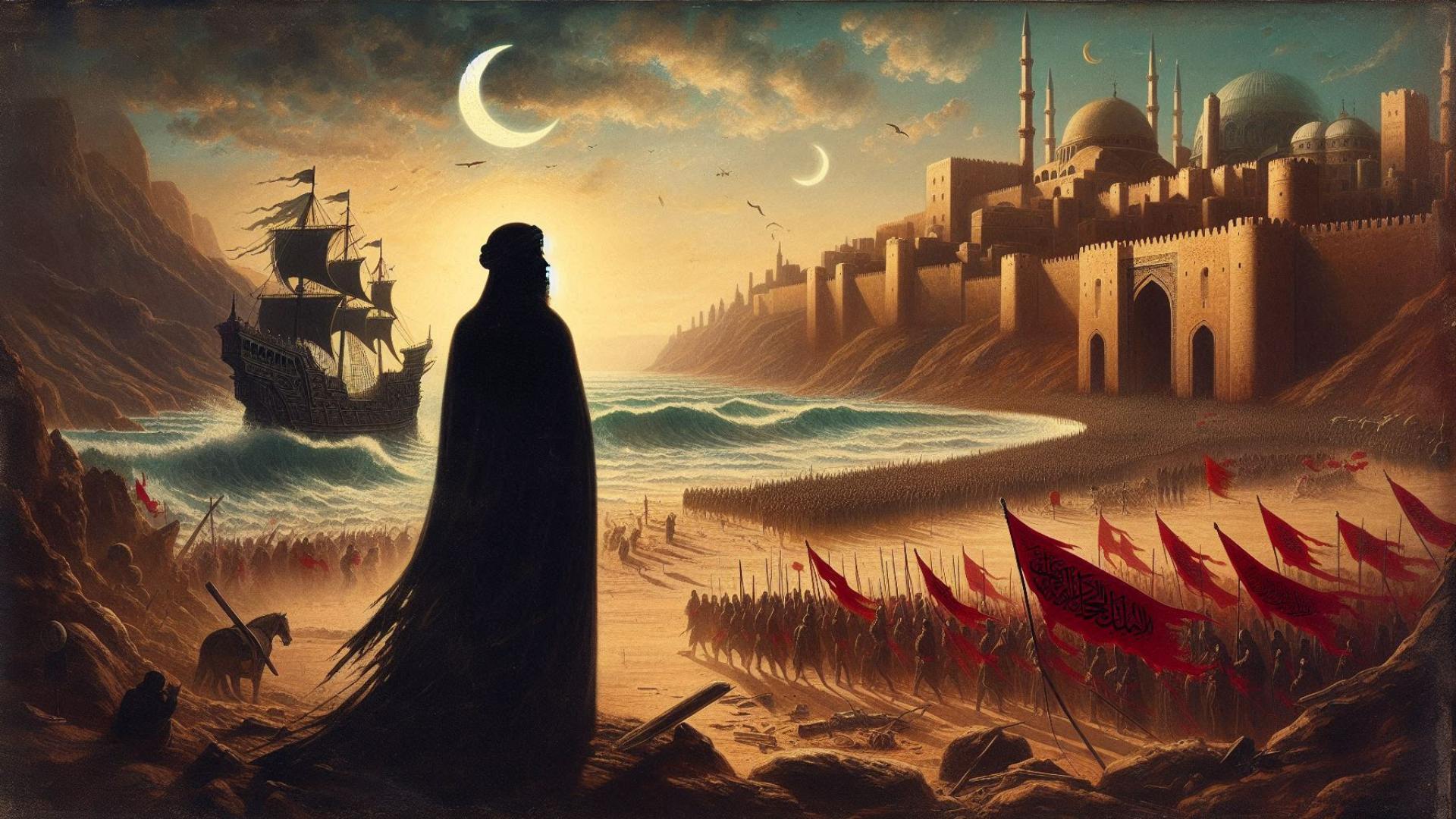
Until his death in 680, Muawiya ibn Abi Sufyan built the first regular Islamic navy, strengthened central authority through his governors, and launched a series of campaigns—targeting, as you might guess, Persia and the Byzantine Empire. Muawiya saw Anatolia as a strategic prize and launched regular raids there; he even besieged Constantinople between 674 and 678. For those who remember their history lessons, this was a first. Although this attempt at conquest ultimately failed, the Islamic armies pushed deep into Anatolia. Sensing his end was near in 676, Muawiya formalized the hereditary system of succession we mentioned earlier. Naturally, this was met with backlash from Ali’s supporters, who viewed it as a crisis of legitimacy, creating a deep political schism between the Umayyads and the rest of the Islamic world. When Muawiya died in 680, his son Yazid took over both the leadership of the Umayyads and the title of Caliph. This triggered a major crisis; Husayn ibn Ali (Ali’s son) refused to recognize Yazid’s legitimacy. In the ensuing conflict, Husayn was killed by the Umayyad army—an event that went down in history as the “Tragedy of Karbala,” which deepened the Sunni-Shia divide that still permeates the Islamic world today. Husayn’s death fueled hatred toward the Umayyads and sparked rebellions, leading Abdullah ibn al-Zubayr to declare his own caliphate in Mecca. The Umayyads couldn’t let this stand. Following a revolt in Medina, which Yazid crushed, the Umayyad army marched on Mecca in 683, using catapults that damaged the Kaaba. This was an incredibly devastating blow to the Islamic world. However, Yazid died during this conflict, forcing the Umayyad forces to retreat.

As the Umayyads weakened in both image and authority, Abdullah ibn al-Zubayr became a massive threat, plunging the Umayyads into a nine-year crisis. Following Yazid’s death, his son Muawiya II (683-684) abdicated shortly after taking the throne, pushing the dynasty into a governance tailspin. During this time, Abdullah ibn al-Zubayr established a de facto government in Mecca. While the Umayyads held onto Damascus, much of the Islamic world pledged allegiance to Ibn al-Zubayr. In 685, Abd al-Malik ibn Marwan took the helm, and the Umayyads began their resurgence. Abd al-Malik first turned his attention to Ibn al-Zubayr in Mecca. After intense fighting, Ibn al-Zubayr was killed in 692, and Mecca returned to Umayyad control. Following this, Abd al-Malik minted the first Islamic coins, made Arabic the official language, and established a solid tax system. The duality within the Islamic world was largely resolved. During the same period, there were wars with the Byzantines, the Turks, and the Khazars. Though there were skirmishes with the Turks, the true historical encounter between the Islamic world and the Turks wouldn’t occur until the Battle of Talas in 751.
Under Abd al-Malik and his son, al-Walid ibn Abd al-Malik, the empire entered a golden age that would last nearly 30 years. The most critical event of this period was Tariq ibn Ziyad’s conquest of al-Andalus in 711, which established Umayyad rule in Spain. This was the Islamic world’s first step into Europe, and it would eventually lead to the rise of the Umayyads of al-Andalus after the fall of the main dynasty. During this same era, North Africa also came fully under Umayyad control.
By this time, the Umayyads had reached the peak of their economic, military, and diplomatic power, but trouble was brewing. Throughout this era of growth, there was a lingering sociological problem: the Arabs continued to treat non-Arab Muslims (known as mawali) as second-class citizens. This resentment culminated in the Berber Revolt, which had devastating consequences for the Umayyads. Already stretched thin by fronts against the Khazars, Turks, Byzantines, and the burgeoning Abbasid threat, the Umayyads were pushed to their breaking point. The Abbasids, emphasizing their lineage from the Prophet Muhammad’s uncle, Abbas, built a narrative of legitimacy and organized the public against Umayyad rule. The people, feeling the sting of inequality, became sympathetic to the Abbasids. Particularly after 740, throne struggles, rebellions, and the sudden rise of the Abbasid threat pushed the empire to the brink. In 750, the Abbasids completely toppled the Umayyads and eliminated almost the entire Umayyad dynasty—with one notable exception: Abd al-Rahman ibn Muawiya.
The Umayyad Emirate of Córdoba (756-1031)
The Umayyads who had conquered al-Andalus and much of modern-day Spain had fallen, but Abd al-Rahman ibn Muawiya managed to escape and reach the region. Thus, an independent emirate was established in al-Andalus, laying the first foundations of the state. You might wonder, “How did he build a state all by himself?” He was joined by the remaining supporters of the Umayyads and, crucially, the Berber tribes. Abd al-Rahman unified the Muslim communities in al-Andalus and captured Córdoba, but because he didn’t recognize the authority of the Abbasids, he did not initially claim the title of Caliph. Naturally, the Abbasids didn’t take this sitting down, so he spent his early years fighting off threats from both the Abbasids and Christian kingdoms. There were also internal frictions between Arabs, Berbers, and local Muslims, but Abd al-Rahman adopted an inclusive approach, strengthening central authority and securing stability.

This period of establishment and struggle continued until 929, when Abd al-Rahman III proclaimed himself Caliph, and al-Andalus suddenly became the most brilliant state in the Islamic world. For the next 200 years, Córdoba became one of the most advanced cities in Europe. al-Andalus reached its zenith in science, art, philosophy, and architecture. Major breakthroughs were made in astronomy, medicine, mathematics, and philosophy. The famous Library of Córdoba housed thousands of books. This was the spark of an Islamic enlightenment that would persist until the Renaissance.

During the reign of Abd al-Rahman III, the state established clear superiority over the fractured Christian kingdoms and expanded its borders. Of course, things didn’t stay that way forever, and this brilliant civilization suddenly entered its final century. The death of Al-Hakam II in 976 triggered a major political crisis. The country fell into the hands of viziers, and the inevitable throne struggles began. With this vacuum of authority, local governors began declaring their independence. Finally, in 1031, the Umayyad state of al-Andalus collapsed entirely, splintering into small Muslim statelets known as taifas. Over time, through the Reconquista, these weakened states were conquered by Christian kingdoms, with the Kingdom of Castile leading the way in laying the political foundations of modern Spain. From that point on, the Iberian Peninsula would be held by the Portuguese and the Spanish, setting the stage for the history we know today.
In short, the Umayyads and the Umayyads of al-Andalus left a lasting mark on Islamic and world history, steering the course of political, cultural, and scientific development.
References and Further Reading
Afsaruddin, & Asma. (2025, June 19). Umayyad dynasty | Achievements, Capital, & Facts. Encyclopedia Britannica. https://www.britannica.com/topic/Umayyad-dynasty-Islamic-history
Khan Academy. (n.d.). https://www.khanacademy.org/humanities/art-islam/chronological-periods-islamic/islamic-art-early/a/the-umayyads-661749-ce
The Editors of Encyclopaedia Britannica. (n.d.). Umayyad Dynasty | Timeline | Britannica. Encyclopedia Britannica. https://www.britannica.com/summary/Umayyad-Dynasty-Timeline
The Editors of Encyclopaedia Britannica. (2019, July 9). Al-Andalus | Facts, History, & Maps. Encyclopedia Britannica. https://www.britannica.com/place/Al-Andalus
Originally published in Turkish at Doğa Filozofu.