
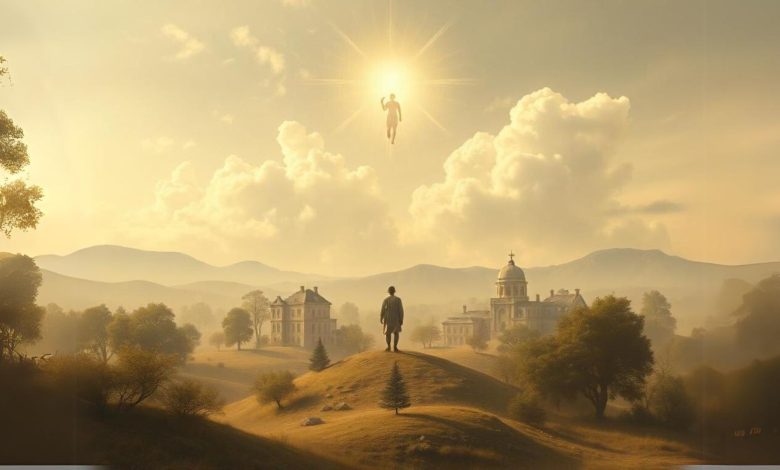
What do objects do when we aren’t looking at them? If a tree falls in a forest and no one is around to hear it, does it make a sound? In short: do objects continue to exist when we aren’t perceiving them? There is one philosopher who spent his life chasing the answers to these questions: George Berkeley.
At first glance, these seem like simple questions, right? We’re tempted to say, “Of course it makes a sound!” or “Obviously, objects keep existing!” At least, that’s our gut reaction. But Berkeley argues that these answers are nothing more than habits and illusions we’ve picked up along the way. Let’s dive in from the beginning and get to know our philosopher a little better.
Who was George Berkeley?
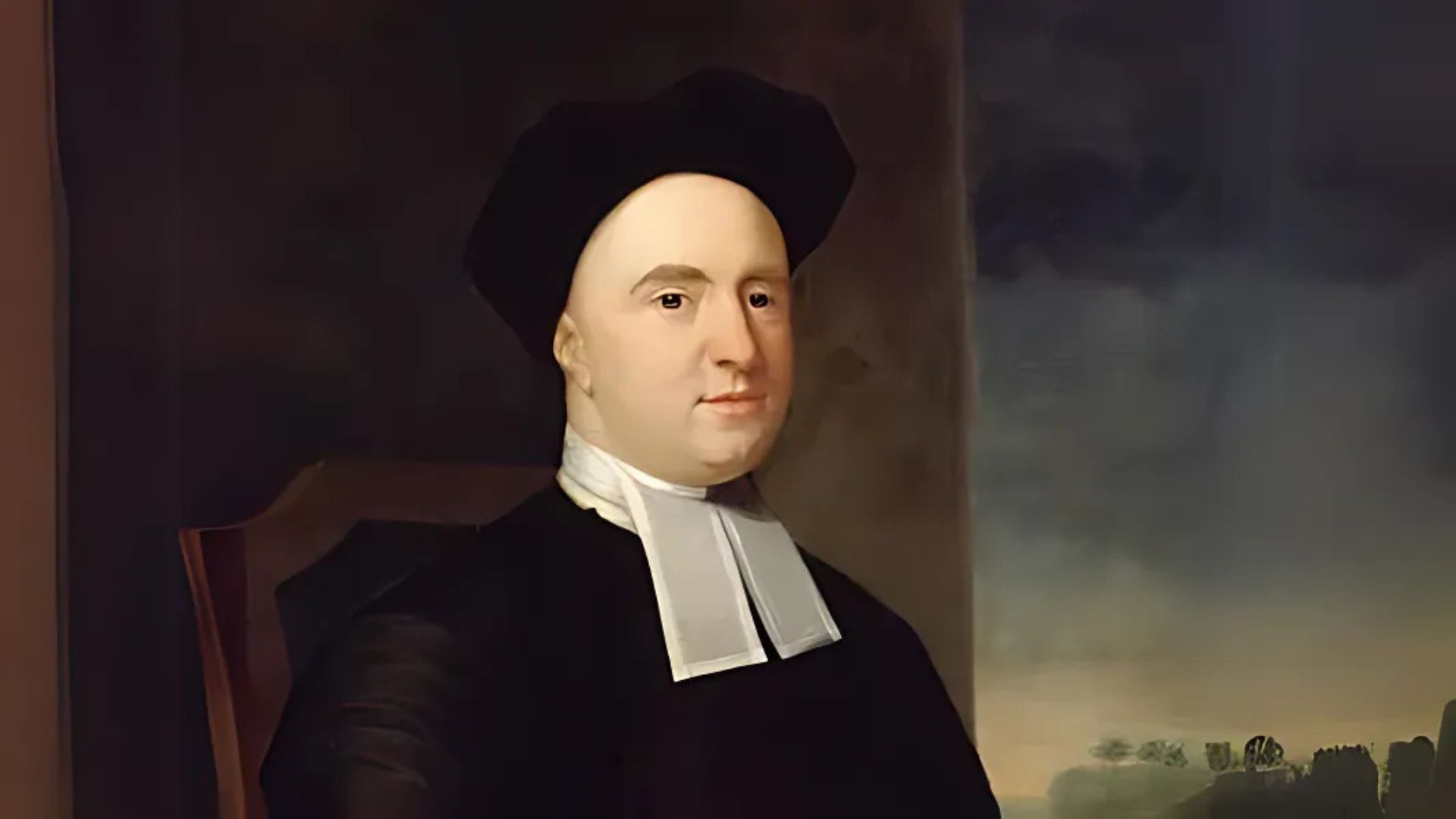
George Berkeley was an Irish philosopher, born in 1685 in Kilkenny, Ireland. He was educated at Trinity College, Dublin, where he began to make a name for himself in the field of philosophy. Berkeley is best known as a pioneer of idealism, and his most famous thesis is: “To be is to be perceived.” We’ll be breaking that down in just a moment.
Before we dive into his thoughts, let’s have a quick refresher on idealism. We touched on this in one of the first articles in this series, our piece on Plato, but a quick reminder never hurts.
Idealism, much like realism or materialism, is a way of approaching the nature of reality. In idealism, the fundamental nature of reality is thought to be mental or spiritual. Even if this school of thought acknowledges the existence of the material or physical world, it views that world as a product of the mind. Idealist philosophers argue that the material world is either created by minds or, at the very least, exists only in the way a mind can perceive it.
Berkeley held this exact belief, though given the time he lived, he built upon Plato’s foundations and approached it from a unique angle. Before Berkeley, thinkers like Spinoza and Descartes had already broken new ground regarding concepts of “reality” and “perception.” Using their work as a springboard, Berkeley sparked a much larger debate—one that would even open the door to the phenomenology that emerged in the second half of the 20th century, which we’ll cover in later articles.
“To be is to be perceived”
Berkeley rejects the idea that the external world exists independently of material objects. To him, what we call the “material world” is actually just a byproduct of our perceptions. If something is not being perceived, it cannot be said to exist. Therefore, an object can only exist as long as it is being perceived. To get a better grasp on this, feel free to revisit our articles on Schopenhauer or Plato, as this stance is quite close to Schopenhauer’s concept of “representation” or Plato’s “reflections.” The only difference is that for Berkeley, the material world is far more fleeting; the only true reality is our perception.

The most fascinating part of Berkeley’s argument is his explanation for how the material world keeps existing. Berkeley argues that the material world has no independent existence, but rather persists because it is constantly perceived by God. Because God is constantly perceiving all objects, those objects continue to exist. Even when humans aren’t looking at an object, God is still perceiving it, which preserves its existence. While many philosophers find this explanation unsatisfying, Berkeley provides much more solid reasoning when he shifts his focus to human perception.

Berkeley claims that everything we perceive is actually a mental representation. Objects in the outside world are just the forms we perceive within our own minds. For instance, when we see a tree, what we’re really experiencing is an image of a tree in our mind. There is no independent “tree” out there; there are only perceptions. This part aligns perfectly with Plato’s theory of the world of forms—the only difference being that Berkeley nearly denies the existence of the material world altogether.
While his predecessors accepted the existence of the material world, Berkeley denies that matter is an independent reality. He refuses to draw a line between the physical properties of objects (like weight or dimensions) and their sensory properties (like color or smell). In his view, all these properties exist only because the mind perceives them. John Locke had argued that sensory qualities like color or smell exist only in the mind, but that physical qualities like weight or length were properties of the physical world itself. Berkeley rejects this; to him, the whole thing is just perception.
Berkeley argues that humans can only acquire knowledge through sensory perception. All information regarding the external world is gained through the senses, and it is meaningless to search for an independent reality beyond them.
This sense of “meaninglessness” stems from the fact that nothing exists unless we perceive it. Interesting, right? After all, if we are perceiving something, we perceive it because it exists. But then, why are we perceiving it in the first place? If the object doesn’t exist, what are we perceiving? Let’s look at the answer.
Berkeley offers this explanation:
We aren’t perceiving a material world; we are perceiving ideas that appear in our minds. The color, shape, and texture of objects are perceived mentally, and their reality is based on these perceptions. In other words, there may not be a physical table out there, but the perception of the table exists in our minds.

So, where does our ability to perceive come from? For Berkeley, the answer is simple: God.
The objects we perceive are ideas placed into or presented to our minds by God. God is constantly perceiving all objects, and because of this, these perceptions exist for us as well. Berkeley views this role of God as critical for ensuring that the world continues to exist and that our perceptions remain consistent.
With these answers, Berkeley presents an even more idealistic picture than Plato. According to him, we humans provide our perception entirely through ideas placed in our minds by God, effectively rendering the material world non-existent.
These are some pretty unusual ideas, aren’t they? Did anyone ever step up to criticize him? Of course they did! Still, the picture Berkeley paints is clear. There is no such thing as a physical world, but because of the ideas God gives us, we believe there is. The reason things continue to exist when we aren’t looking is simply that God is perceiving everything at every moment. That, in a nutshell, is the core of Berkeley’s idealism. But what do you think? Does a tree falling in a forest really make a sound if no one is there to hear it?
References and Further Reading
Berkeley, George | Internet Encyclopedia of Philosophy. (n.d.). https://iep.utm.edu/george-berkeley-british-empiricist/
Duignan, B. (1998, July 20). George Berkeley | Biography, Philosophy, & Facts. Encyclopedia Britannica. https://www.britannica.com/biography/George-Berkeley
George Berkeley (Stanford Encyclopedia of Philosophy). (2011, January 19). https://plato.stanford.edu/entries/berkeley/
Originally published in Turkish at Doğa Filozofu.