

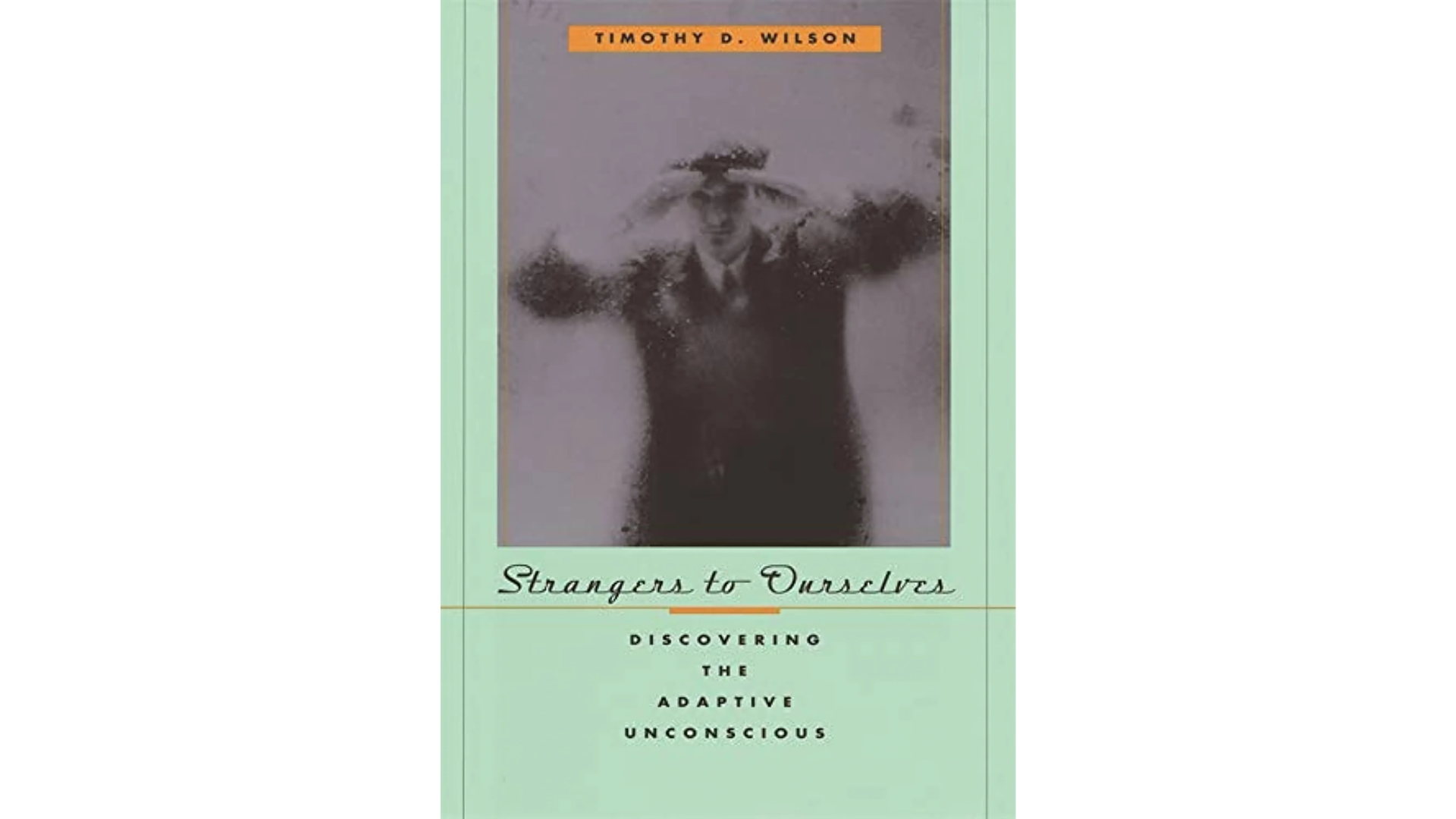
How well can we actually know ourselves? We like to think that the decisions we make, the emotions we feel, and the beliefs we hold are all products of a conscious, deliberate process. But is that really the case? Recent research in psychology suggests that, more often than not, we don’t understand ourselves nearly as well as we think. Timothy Wilson’s work, Strangers to Ourselves, pulls back the curtain on how our unconscious mind steers the ship and why our own introspection is often unreliable. In this post, as we do with every entry in our series, we’ll get to know our author a little better before diving headfirst into the pages of his work!
A Quick Intro to Timothy Wilson
Wilson is someone who navigates the deep waters of psychology without getting bogged down in that dry, academic jargon we all know too well. You know the feeling—when you pick up an academic book or paper and it feels like you’re reading a different language? Wilson isn’t like that. He explains his ideas with total clarity. And what is he so concerned with? He’s on a mission to answer one question: “How well do we really know ourselves?”

Wilson details this question extensively in his book Strangers to Ourselves. The answer is simple: Probably much less than we think. Wilson argues that our unconscious mind is actually running the show for most of our lives, and we frequently misinterpret these processes. In other words, the stories we tell ourselves about who we are are often just works of fiction!

A professor at the University of Virginia, Wilson hasn’t kept these insights locked away in academic journals; he’s brought them to a wider audience through books like Strangers to Ourselves and Redirect. While he might not be a household name in Turkey, his books are highly regarded as seminal works in the US and Europe. Strangers to Ourselves reveals that we rely far too heavily on our unconscious while understanding it far too little. Think of it as an algorithm running in the background of your brain that you aren’t even aware of; when we try to decode this algorithm, we’re usually looking in the wrong places.
Wilson has also collaborated with Daniel Gilbert on research regarding human expectations of happiness. You know, those questions we all ask: “Will I be happier if I quit this job?” or “Will my life change if I buy this house?” Spoiler alert: people are usually terrible at making those predictions. In short, Timothy Wilson is a psychologist who exposes how we fool ourselves, and he does it in an entertaining way rather than a mind-numbing academic one.
Now, let’s get to his masterpiece! Let’s take a look at the work where he tackles this delusion in detail. And remember: even at the end of every book summary, there’s still a whole book left to explore. There are plenty of examples and concepts waiting for you inside the pages. If what we share here piques your interest, we highly recommend picking up a copy!
Strangers to Ourselves
According to Wilson, our conscious mind thinks of itself as the captain of a great ship. But in reality, something else is holding the wheel: the unconscious mind. Like a computer, our brain is constantly processing data and making decisions in the background. We, however, only see the small window open on the screen. These background processes are sometimes so fast and intuitive that they don’t even let us notice them. We touched on a similar idea in one of the first posts of our Reading Guide series, where we discussed the book Thinking, Fast and Slow. The System 1 and System 2 framework there runs parallel to Wilson’s narrative. So, how do these systems actually work?
Let’s say you meet someone new and you immediately warm up to them—or conversely, something makes you uneasy. We say “first impressions matter,” but what’s actually happening is your unconscious processes blending with your past experiences to reach a lightning-fast judgment. And the funny part? When we try to explain why we reached that judgment, we usually come up with the wrong reasons!
Let’s play out a scenario: someone asks you, “Why do you feel that way?” and you give them a long, detailed explanation. But is that explanation actually accurate? Aren’t you adding your own little justifications after the fact? According to Wilson, we do this involuntarily, often to the point of fooling ourselves. In this sense, our self-assessments are riddled with flaws. Our minds create stories after the fact to try and fit our emotions and decisions into a logical framework.

For instance, when you think about why you bought a certain product, you might say, “Because it’s high quality and durable,” but perhaps it was the charismatic actor in the commercial who influenced you without you even realizing it. To Wilson, this is far more likely than you’d think. If you really think about it, we remember most brands from their TV ads, or even from the people in those ads who have nothing to do with the actual product.
Wilson even suggests we do this when trying to understand our own feelings. Someone expecting a big promotion thinks it will change their life and make them incredibly happy. But in reality, that happiness might last a few weeks before they settle back into their old routine. Or someone going through a breakup says, “I’ll never get over this,” only to find themselves happy with someone else a few months later.
So, What’s the Solution?
According to Wilson, there is a way to reduce these misguided predictions and partial understandings. Instead of blindly trusting our introspection, he suggests it’s more useful to observe our own behavior. For example, if you claim, “I’m a very patient person,” but you get angry at the slightest thing in traffic, perhaps you aren’t as patient as you thought!

Ultimately, Wilson’s work reveals that we aren’t as good at understanding ourselves as we’d like to believe. While our unconscious largely shapes our decisions and emotions, our conscious mind is often busy misunderstanding the process and spinning false narratives. However, by carefully observing our behavior, seeking feedback from others, and working to improve our insights, we can better grasp these unconscious processes. Understanding ourselves isn’t just about looking inward—it’s about following the breadcrumbs our unconscious leaves behind.
References and Further Reading
Clear, J. (n.d.). Strangers to ourselves by Timothy Wilson: Book summary. James Clear. https://jamesclear.com/book-summaries/strangers-to-ourselves
Philosophy at the University of Edinburgh. (2019, May 31). Adaptive unconscious: 1. Strangers to ourselves [Video]. YouTube. https://www.youtube.com/watch?v=Lu-MKYb56PA
SF Walker. (2022, October 26). Strangers to ourselves by Timothy Wilson book review – Discovering the adaptive unconscious [Video]. YouTube. https://www.youtube.com/watch?v=PPcWpKM_UXg
The RSA. (2011, September 5). Redirect with Timothy Wilson [Video]. YouTube. https://www.youtube.com/watch?v=Tk4bdpA6oz4
Wilson, T. D. (2002). Strangers to ourselves: Discovering the adaptive unconscious. Belknap Press of Harvard University Press.
Wilson, T. D., Reinhard, D. A., Westgate, E. C., Gilbert, D. T., Ellerbeck, N., Hahn, C., Brown, C. L. and Shaked, A. (2014). Just think: The challenges of the disengaged mind. Science, 345(6192), 75–77. https://doi.org/10.1126/science.1250830
Originally published in Turkish at Doğa Filozofu.