


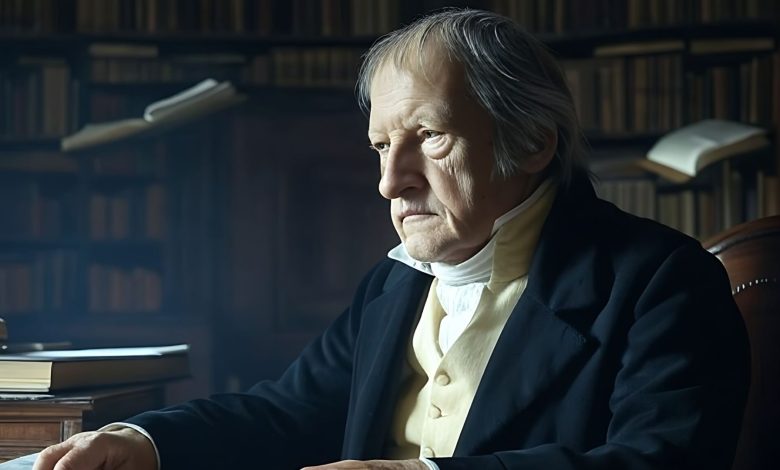
Welcome back to our philosopher series! In this post, we’re diving into the life and work of a truly monumental thinker: Friedrich Hegel.
Hegel is one of the heavyweights who shaped Western philosophy. His impact was so profound that every philosopher who followed him had to contend with his system in one way or another. But what exactly did Hegel do to earn such a legendary status?
The Dialectical Method
One of the biggest contributions that cemented Hegel’s place in history is his development of the dialectical method. Don’t panic—we’ll break down every concept as we go. The dialectical method suggests that every idea or situation (the thesis) contains an internal contradiction (the antithesis), and that this contradiction must be resolved through a synthesis. For Hegel, this doesn’t just apply to our individual thoughts; it’s a rule that governs social sciences like history. Even though it wasn’t his original field, this narrative of his would later play a crucial role in the theories of historians and political ideologies alike. Let’s take a closer look at how this works.
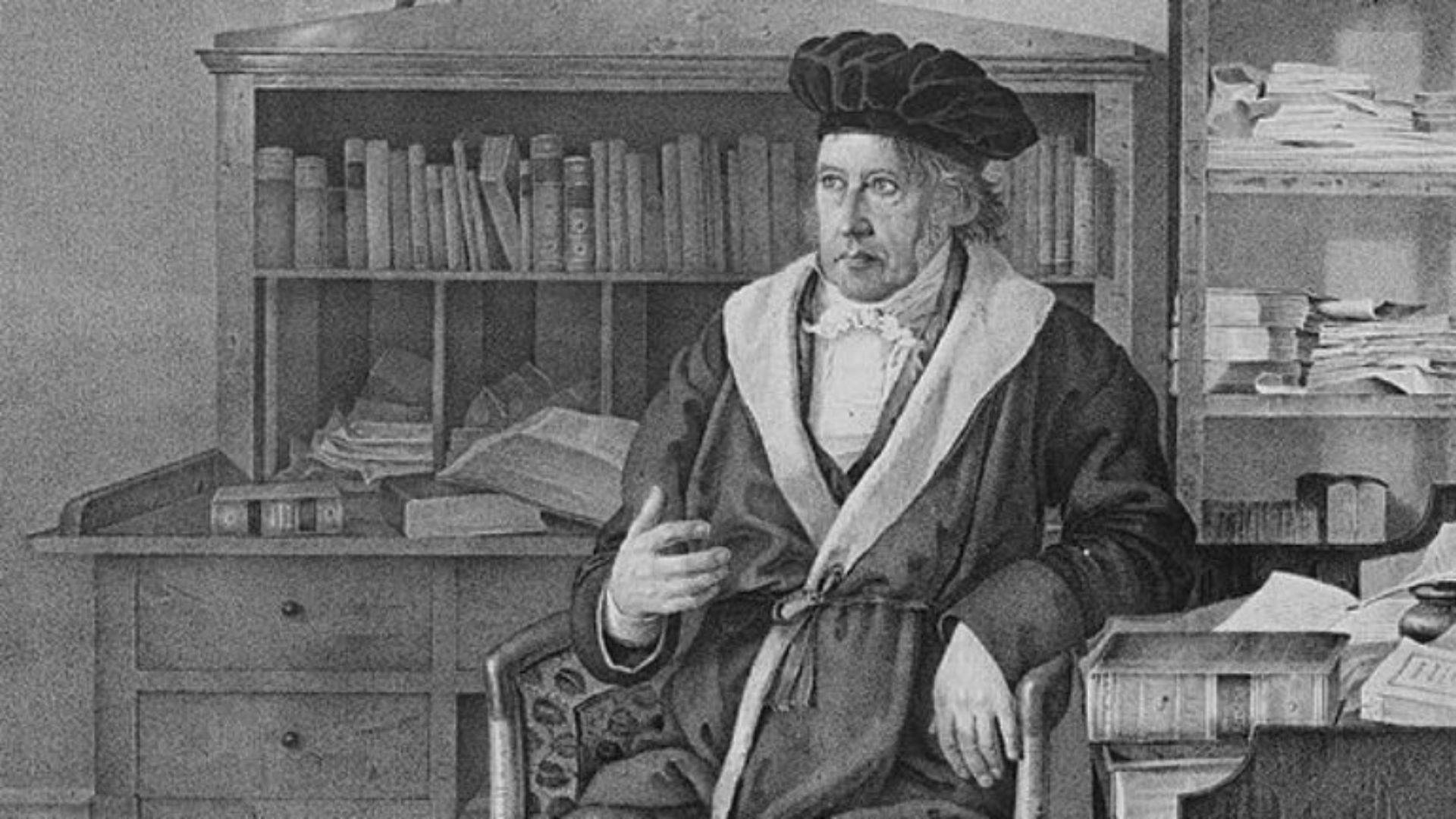
Let’s start with the thesis. The thesis is the starting point of a situation, idea, or state of being. It’s how something exists in its initial form. However, in this state, it isn’t complete; it requires progress to resolve the contradictions hidden within it. We’ll see this more clearly once we bring in the antithesis.
While the thesis might look like the final state of a matter, for Hegel, it’s full of potential. Because the thesis contains limitations and flaws, it inevitably gives birth to an opposing state (the antithesis). Any idea or state of being always carries a contradiction within itself; this contradiction will eventually clash with the antithesis that emerges later in the process.
For example, a society’s concept of freedom might be very limited at first. In that state, freedom remains a privilege accessible only to a certain class or group of people. In this form, it cannot be considered true freedom. Therefore, an antithesis—and subsequently, a synthesis—becomes necessary.

The antithesis, in its simplest form, is the opposite or counterpoint to the thesis. It exposes the limitations and shortcomings of the thesis. But the antithesis isn’t just a rejection; it’s a necessary component for resolving the conflict. Let’s simplify: imagine a friend tells you, “Tufan Özdemir’s articles on Doğa Filozofu are incredible! He’s a flawless writer!” Your friend has just presented you with a thesis. You might respond, “Yes, but he doesn’t write much about culture and art. So, we can’t call him flawless. Also, his articles aren’t perfect for these specific reasons.” You’ve just provided an antithesis. You’ve challenged the thesis. Notice how the antithesis pointed out the gaps in the original statement, but you haven’t reached a new understanding yet. That’s where the synthesis comes in.
Hegel argues that after the clash between the thesis and the antithesis, a synthesis is required to reach a more accurate judgment. However, the synthesis isn’t an end point; it’s the beginning of a higher level. Because the synthesis itself will eventually turn into a new thesis, and the same dialectical process will begin all over again. For this reason, Hegel’s dialectic should be understood as a process of “constant evolution.” No idea or situation reaches an absolute end; there is always a new contradiction, a new process of development. In our example, the synthesis might conclude that “Tufan Özdemir’s writing is excellent, even if not perfect, and while he doesn’t cover culture and art extensively, he produces great work in many other fields.” Even this statement becomes a new thesis, and new antitheses can always be generated. This is what makes the dialectic an infinite loop.

In short, the dialectical relationship between thesis, antithesis, and synthesis is more than just a logical structure. According to Hegel, this relationship defines the fundamental structure of existence, thought, societies, and history. A dialectical process suggests that everything is in a state of development, change, and transformation. This process shows that while everything exists through opposites and contradictions, these very contradictions are the engine of progress. This elevates Hegel’s theory of concepts to an extraordinary level.
The Absolute Spirit (Geist)
Now, let’s move on to another essential concept: The Absolute Spirit!
For Hegel, the Absolute Spirit is the final stage where both individual and social consciousness evolve. This concept refers to a level where consciousness fully grasps itself, existence, and reality. The Absolute Spirit represents reaching a universal understanding that transcends the limits of individual thought.

In Hegel’s system, the Absolute Spirit is the peak of humanity’s effort to understand its own nature and the world through art, religion, and philosophy. This concept expresses the realization of universal unity and the highest form of human consciousness. According to Hegel, human history is a process of consciousness getting to know itself. This process aims for a peak where consciousness achieves freedom and wholeness on both individual and social levels. In other words, the Absolute Spirit is the ultimate goal of history: Throughout history, humanity has struggled to push itself toward a higher level of consciousness. All the contradictions and divisions we discussed regarding the thesis and antithesis are resolved at the level of the Absolute Spirit. Hegel examines the evolution of this Absolute Spirit in three stages: Subjective Spirit, Objective Spirit, and Absolute Spirit.
The first stage, the subjective spirit, refers to the development of individual consciousness. The human first tries to understand their own individual nature and consciousness. Here, the individual perceives the world from their own perspective and sees themselves as an entity separate from their surroundings. Think of it as the state of mind that develops during childhood. Later, with the objective spirit stage, the individual becomes aware of social life and rules. Social structures like law, morality, and ethics allow individual consciousness to merge with social consciousness. The Objective Spirit is the stage where the individual integrates into society and internalizes its values. Essentially, this is the period of awareness that comes with adulthood.

The Absolute Spirit is the level where the unity is realized and the contradictions between individual and social consciousness—which we mentioned earlier—are resolved. At this stage, the human realizes they are not just an individual or a social being, but also possess a universal consciousness. This is the human understanding the world and themselves as a whole. According to Hegel, this stage is reached through art, religion, and philosophy.
The Phenomenology of Spirit
Following the Absolute Spirit and the dialectical method, Hegel brings us a brand-new work: The Phenomenology of Spirit.
This work describes human consciousness as a journey moving from a pure beginning toward the Absolute Spirit. On this journey, consciousness doesn’t just perceive the external world; it discovers itself and reaches a higher state of knowledge in the process of making sense of things. Phenomenology provides a deep analysis of the stages humans go through while trying to understand themselves and the world. Let’s take a closer look at the details of this process. In this section, Hegel describes the process of the absolute spirit we just discussed. Then, he tries to understand how we perceive the external world.

According to Hegel, consciousness doesn’t just perceive objects; it begins to use intellectual tools to interpret and conceptualize those perceptions. Hegel’s stage of perception is where consciousness begins to understand the external world in a social and moral context for the first time. At this stage, consciousness doesn’t just observe the external world; it begins to interpret objects in the world in a more complex way.
For Hegel, perception means that beyond the subject’s direct relationship with an object, the subject begins to understand its own internal structure. In a sense, this expresses a movement from the external world to the internal world. During this process, consciousness begins to make its relationship with the external world more complex and starts to think about the things it previously only perceived.

However, in Hegel’s understanding of perception, perception doesn’t just enable us to see the external world objectively; it also carries a kind of illusion. As humans try to understand the world through perception, the differences between themselves and the world become even more apparent. At this point, the individual must develop more sophisticated intellectual tools to understand the world.
In other words, Hegel explains how human consciousness develops and how it sees the world through perception. We can call it a journey of self-discovery. In fact, Hegel starts to define his own individual existence in different ways. For example, right now you might be a reader; after finishing this article, you might be a student; after class, you might be a roommate or a partner. This shows that there isn’t a single element that makes us who we are.
Let’s understand this journey of identity better through one of his examples:
Suppose two people meet in a desert in the middle of nowhere. In this encounter, both consciousnesses want to establish “dominance” and be recognized. This can turn into a physical struggle. Hegel says here that individuals aren’t just interested in survival; they also want to have their “value” recognized by others. In this struggle, one of the parties retreats out of fear of death and takes on the role of the “Slave,” while the other becomes the “Master.” In this situation, the master feels superior and powerful, while the slave, having submitted, begins to do the master’s bidding. Here, Hegel develops an interesting approach: in this new situation, the master is dependent on the slave because they receive service from them. However, this service doesn’t “truly” complete the master’s identity. Because the master is not genuinely accepted by the slave; the slave only submits out of necessity.

The slave, meanwhile, transforms the world while working and begins to discover themselves in the process. That is, the slave’s consciousness develops through their labor. Over time, the slave realizes that they are the one changing the world and begins the path to liberation. Returning to the dialectical side of things: let the master be the thesis and the slave be the antithesis. Over time, this relationship can flip, and this opposition transforms to give birth to a new meaning. With this example, Hegel explains that freedom is not born from force or dominance, but from mutual recognition and the transformative power of labor. Later, Marxism would place this exact example at its core.
It seems like a good place to stop for now. Hegel is a truly versatile philosopher whose narratives apply to far more complex processes than what we’ve covered here. Thanks to Hegel, brand-new systems will be built, and entirely new movements in philosophy and politics will be born.
References and Further Reading
Encyclopædia Britannica, inc. (2025, February 20). Georg Wilhelm Friedrich Hegel. https://www.britannica.com/biography/Georg-Wilhelm-Friedrich-Hegel
Hegel, Georg Wilhelm Friedrich (2018) [1807]. The phenomenology of spirit. Cambridge Hegel Translations. Translated by Pinkard, Terry. Cambridge: Cambridge University Press
Kaufmann, Walter Arnold (1965). Hegel. Reinterpretation, Texts, and Commentary.
Redding, P. (2020, January 9). Georg Wilhelm Friedrich Hegel. Stanford Encyclopedia of Philosophy. https://plato.stanford.edu/entries/hegel/
Shuangli, Zhang, ‘Marx and Hegel’, in Dean Moyar (ed.), The Oxford Handbook of Hegel, Oxford Handbooks (2017; online edn, Oxford Academic, 6 June 2017)
Wikimedia Foundation. (2025, February 14). The phenomenology of spirit. Wikipedia. https://en.wikipedia.org/wiki/The_Phenomenology_of_Spirit
Originally published in Turkish at Doğa Filozofu.