



Contrary to popular belief, science and philosophy are two sides of the same coin. Both share a singular goal: to uncover the nature of the concepts and phenomena we don’t yet understand. Through philosophy, we learn to ask the right questions and identify our blind spots. Through science, we find the answers to those questions and turn them into practical tools for our daily lives. The idea that science and philosophy are at odds is a misconception; in reality, they are two essential paths toward the truth. The fact that many philosophers were also renowned figures in mathematics, medicine, and physics is a testament to this. One of the best examples of this synthesis is none other than Schrödinger himself.
Schrödinger is one of those rare figures who left an indelible mark on both the history of philosophy and the history of physics. So, what is it that places him at the intersection of these two fields? Let’s dive in and find out.

Who Was Schrödinger?
Before we unpack how he bridged the gap between physics and philosophy, let’s get to know the man behind the name.
Erwin Schrödinger was born on August 12, 1887, in Vienna, Austria. His father, Rudolf Schrödinger, was a factory owner and botanist, while his mother, Georgine Emilia Brenda, came from an Austro-British family. Growing up in this intellectually and culturally vibrant environment helped nurture Schrödinger’s interest in science from a very young age.
Schrödinger began his physics studies at the University of Vienna, where he followed in the footsteps of giants like Ludwig Boltzmann. He completed his PhD in physics in 1910, showing a deep interest in both theoretical and experimental physics throughout his university years.
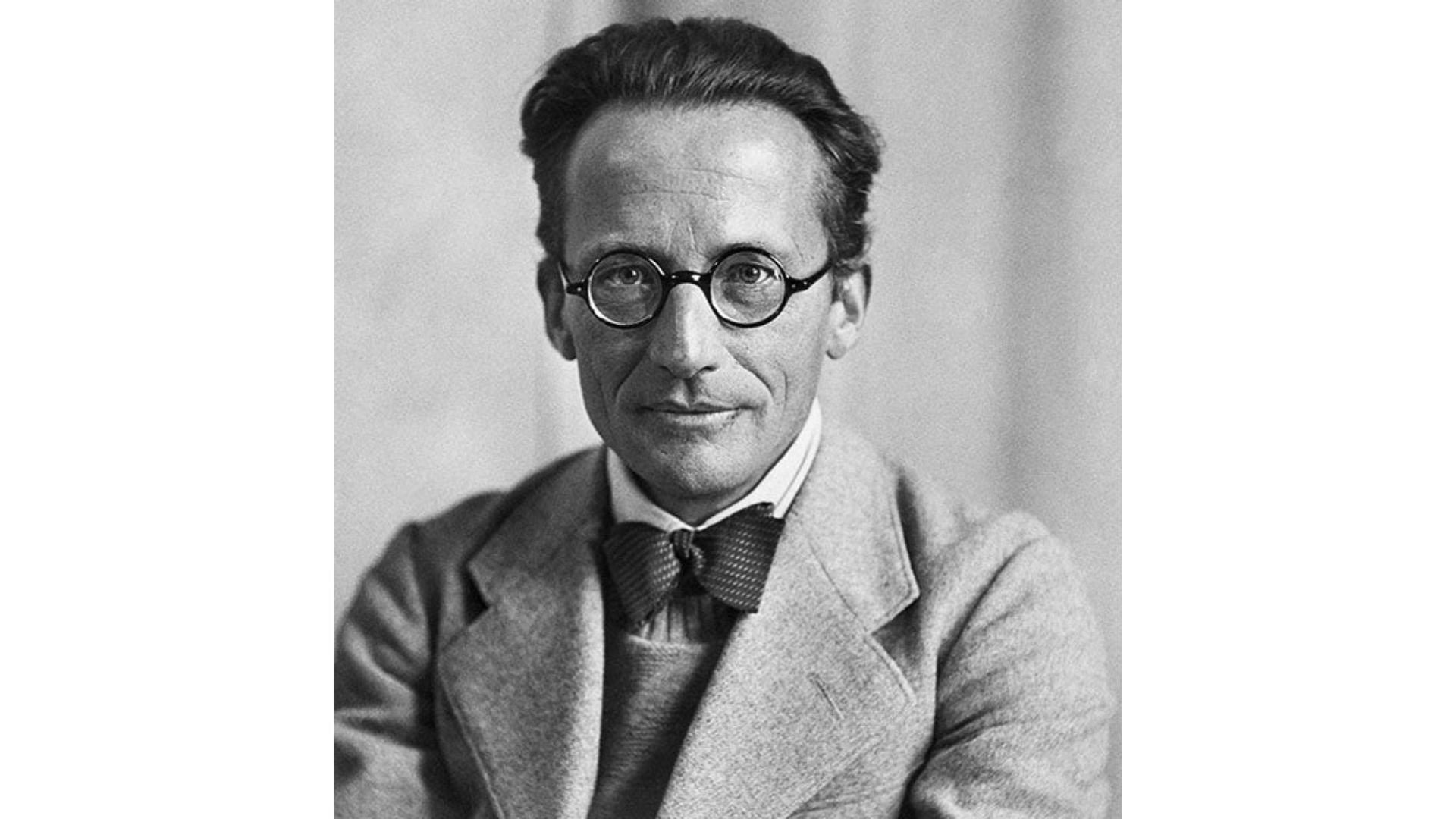
Yes, we know—that was a pretty dry, textbook-style biography. But it does get an important point across: Schrödinger was a man who made monumental contributions to science, particularly physics. His primary focus was on quantum mechanics—a field we still discuss today, and one that remains shrouded in mystery.
In 1921, Schrödinger became a professor at the University of Zurich. It was there, in 1926, that he made his greatest contribution to quantum mechanics: the Schrödinger Equation. This equation serves as the bedrock of quantum mechanics, describing the behavior of subatomic particles. We’ll look at that more closely in a moment. With this new approach, known as wave mechanics, Schrödinger used quantum theory to explain the duality between waves and particles.
Everything sounds pretty heavy on the physics side so far, right? That’s because it is. The rest of this piece might carry that same scent, but don’t worry—philosophy is just around the corner.
The Schrödinger Equation
Throughout his life, Schrödinger used physics as a lens to explain life and the universe. His ultimate passion was to understand the nature of life itself. He was deeply curious about the role of the observer in quantum mechanics and how consciousness might be woven into these physical processes. The idea that a system doesn’t settle into a definite state until it is observed led him to wonder about the impact of consciousness on the physical world. Schrödinger questioned how consciousness might function not just as an observer, but perhaps as a fundamental building block of the universe.
To put it simply, Schrödinger was asking: “Does anything exist if we aren’t there to perceive it?” He aimed to answer that through the quantum lens.
Now that we’ve framed that, we can dive into what his equation actually does.
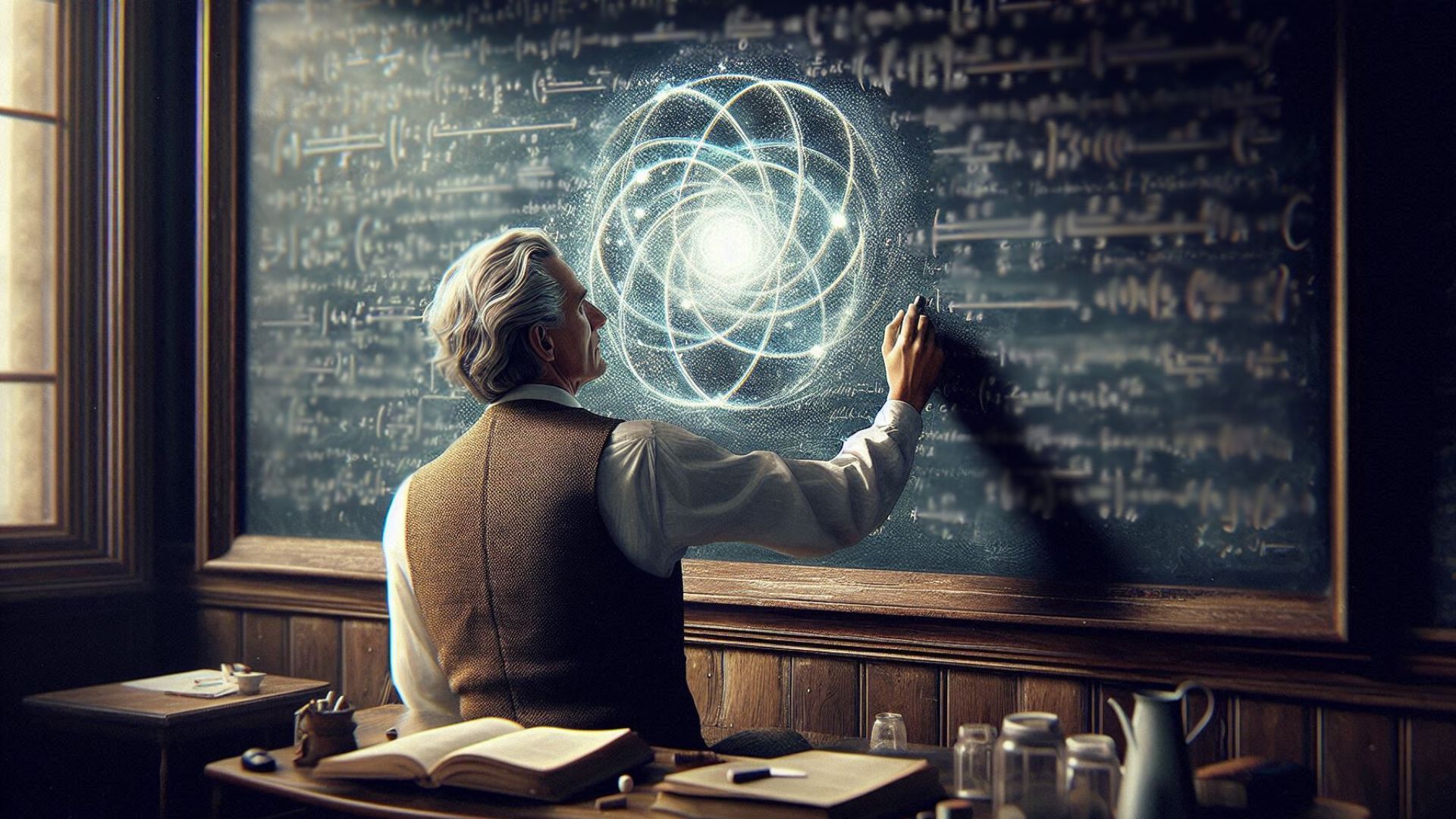
Long before Schrödinger, Isaac Newton had defined the laws of classical physics, which focused primarily on the motion of matter. This system worked perfectly well—until the concept of the “quantum” emerged in Schrödinger’s time. Once we realized there was a reality beyond what we could perceive in our everyday lives, Newton’s explanations began to fall short. That is why Schrödinger developed a new system: the Schrödinger Equation.
The Schrödinger Equation became the quantum counterpart to Newton’s laws of motion. While Newton’s laws could precisely define an object’s motion and position at any given moment, the Schrödinger Equation doesn’t tell us exactly where a particle is; instead, it defines the probability of it being in a certain place. In short, the entire system is built on probability.
This equation helps us understand the behavior of atoms, molecules, and larger systems. The solution to the equation shows the probabilities of finding a particle at specific energy levels. This allowed us to better understand atomic and molecular structures and the strange behavior of quantum systems.
I can hear you saying, “It still doesn’t feel like we’ve reached the philosophy part.” You’re right, because the real question came only after this equation was born.
Schrödinger’s Cat
While the Schrödinger equation was incredibly important, it wasn’t easily grasped, and its necessity was questioned in many circles. With this in mind, Schrödinger came up with a thought experiment in 1935 to better illustrate the differences and contradictions between classical physics and quantum physics. The experiment goes like this:
Imagine a cat. This cat is placed in a sealed box with a radioactive atom, a Geiger counter (a radiation detector), a flask of poison, and a hammer. There is a 50% chance that the radioactive atom in the box will decay within an hour, and a 50% chance it won’t. If the atom decays, the Geiger counter detects it, causing the hammer to shatter the poison flask, which kills the cat. If the atom does not decay, nothing happens, and the cat remains alive.

Ultimately, there is a 50/50 chance for either outcome, but because all of this is happening inside a sealed box, the state cannot be definitively observed.
(Superposition: Before we go any further, we want to explain a concept we’re about to encounter. Superposition is a term frequently used in the quantum world, and it means this: A quantum particle can exist in multiple places or states at once, much like a beam of light can behave as both a wave and a particle. For example, an electron can be in two different energy levels or two different locations simultaneously. This remains true until a measurement is taken. Once measured, the electron “collapses” into one of these probabilities and is found in a definite state.)
In other words, until you measure it, that thing can represent every possibility at once.)
Now, back to our experiment.
According to the quantum principle of superposition, the atom is in a superposition of being decayed and not decayed—it exists in both states simultaneously. Consequently, the cat is also in a superposition of being both alive and dead.

The Schrödinger’s Cat thought experiment addresses what is known in quantum mechanics as the “measurement problem.” This problem suggests that a quantum system’s definite state is determined only when a measurement is taken (i.e., when it is observed by an observer). The moment you open the box to observe the cat, the system’s superposition collapses, and the cat becomes either completely alive or completely dead. However, before the box is opened, the cat exists in both states at the same time.
If you’re asking, “Okay, but what does this have to do with anything?” let’s clear that up quickly. Earlier, in the “Schrödinger Equation” section, we explained the difference between quantum and classical physics like this:
“While Newton’s laws could precisely define an object’s motion and position at any given moment, the Schrödinger Equation doesn’t tell us exactly where a particle is; instead, it gives the probability of the particle being in a certain place.”
With this thought experiment, Schrödinger was communicating why we cannot fully measure the quantum world. By doing so, he laid bare the strange nature of quantum mechanics that contradicts our classical understanding. This experiment shows how incompatible quantum mechanics can be with our daily experiences. With this experiment, Schrödinger ignited a debate about what quantum mechanics means for the macroscopic world.
It is right here—through the questions he asked, the thought experiment he created, and the brand-new understanding he unveiled—that Schrödinger bridged the pillars of physics and philosophy in a truly unique way.
Reflections
With this thought experiment and his equation, quantum studies gained momentum. His approach paved the way for new developments, leading to modern innovations like quantum computers and the theory of the multiverse.

Schrödinger’s legacy has been immortalized by his contributions to the foundations of modern physics and quantum mechanics. The Schrödinger Equation and the Schrödinger’s Cat thought experiment are his primary works that cemented his name in the history of science. Furthermore, his book “What is Life?” and his reflections on the philosophy of science have had a profound impact on the fields of biology and philosophy. As a thinker who pushed the boundaries of science, Schrödinger left a deep mark on both physics and many other disciplines.
Don’t worry, no animals were harmed during the making of this thought experiment!
References and Further Reading
Bernstein, J. (2024, September 17). Erwin Schrodinger | Biography, Atomic Model, Cat, & Facts. Encyclopedia Britannica. https://www.britannica.com/biography/Erwin-Schrodinger
Matthias, M. (2023, November 27). Schrodinger’s cat | Definition & Facts. Encyclopedia Britannica. https://www.britannica.com/science/Schrodingers-cat
The Editors of Encyclopaedia Britannica. (2024, September 13). Schrodinger equation | Explanation & Facts. Encyclopedia Britannica. https://www.britannica.com/science/Schrodinger-equation
What is superposition and why is it important? (n.d.). Caltech Science Exchange. https://scienceexchange.caltech.edu/topics/quantum-science-explained/quantum-superposition
Originally published in Turkish at Doğa Filozofu.