

Powerful enough to bring the world to a standstill, effective enough to confine all of humanity to their homes—all while being about 100 times smaller than a single cell: viruses. You may have noticed that when we talk about these microscopic entities, we can’t quite bring ourselves to call them “alive.” That’s because whether viruses are truly alive or inanimate remains one of the most stubborn and debated questions in biology, a puzzle that has haunted the scientific world for years. In this piece, let’s take a closer look at viruses to explore their characteristics and how they came to be.
Are Viruses Alive?
To answer that, we first need to define what “alive” actually means. In biology, life is a concept used for entities formed by the assembly of simple structural molecules or complex organ systems that can maintain their functions by adapting to their environment as much as possible. For an organism to be considered alive, it must meet certain criteria. We can list these as Movement, Respiration, Sensitivity, Nutrition, Excretion, Reproduction, and Growth. The reason we can’t classify viruses as living is that they don’t fulfill all seven of these requirements. Viruses cannot reproduce on their own, they lack a cellular structure, they have no metabolism of their own, and because they lack cytoplasm, a nucleus, or organelles like other cells, they have almost no way to monitor their internal state or maintain homeostasis (an organism’s attempt to keep its internal environment balanced against external changes). Another test where viruses fail is growth. Living things use energy and nutrients to grow and become larger or more complex. Viruses, however, lack the ability to grow or increase in complexity independently.
While the reasons listed above keep us from calling viruses “alive,” the fact that they share certain features with living things makes the issue much more complicated. Most fundamentally, just like other living things, viruses possess genetic material. Some contain DNA, some contain RNA, and some viruses can even contain both. Another critical point is that while they cannot reproduce independently, they can increase in number by hijacking the cellular machinery of a host cell to copy and assemble their genetic material.
Viruses also possess the ability to adapt and adjust, just like other living organisms. They can evolve through mechanisms like natural selection, recombination, and mutation. When two viruses infect the same cell simultaneously, they can swap genetic material to create new strains. This process is called recombination. For example, the Influenza A H1N1 virus was formed by the mixing of genetic material from human, swine, and avian flu viruses. Genetic material from bird and pig viruses—which don’t typically infect humans—was added to the H1N1 virus, creating a new strain. Consequently, this virus spread rapidly among humans in 2009 and caused a pandemic.
When an error occurs during the replication of a virus’s DNA or RNA, the virus undergoes mutation, leading to the emergence of a new virus with different genetic traits. Some viruses, especially those containing RNA, mutate quite easily. These are the ones that have historically given humanity the most trouble. For example, HIV (Human Immunodeficiency Virus), Coronaviruses, and Hepatitis C (HCV) mutate very frequently. Another example is the influenza (flu) virus. Its rapid rate of mutation leads to the emergence of different strains every year, which is why we have to develop a new flu vaccine annually.
In summary, scientists are pretty much in agreement that viruses cannot be called “alive.” Yet, precisely because of the features we’ve discussed, we can’t label them as entirely “inanimate” either. Therefore, the most logical answer to this question—which has remained unanswered since the discovery of viruses—is that they are best accepted as an intermediate form between the living and the non-living.
How Did the First Virus Form?
But how did these viruses—which are neither fully alive nor fully inanimate, yet capable of holding cells hostage and even causing the death of living things—come to be? Here are the three theories scientists hold on the matter:
The first theory, the Escape Theory, suggests that the genes coding for viruses may have originally come from single-celled organisms like bacteria. Small sections of DNA might have escaped from a cell’s genome and eventually acquired a protein coat to form the viral structure we know.
The second theory argues that viruses were once cells themselves, but over many generations of parasitism, they lost most of their genes because they were no longer needed. This theory is supported by the discovery of a virus called the “Mimivirus.” At 750 nanometers in diameter, these viruses are gargantuan compared to others. Mimiviruses also carry more genes than they should need. Furthermore, some of these genes are used for protein synthesis—which, as we mentioned earlier, is something viruses usually cannot do on their own. This unusual species leads researchers to suspect that viruses were once single-celled organisms that, over time, adopted parasitic traits and evolved into the living-non-living hybrid form we see today.
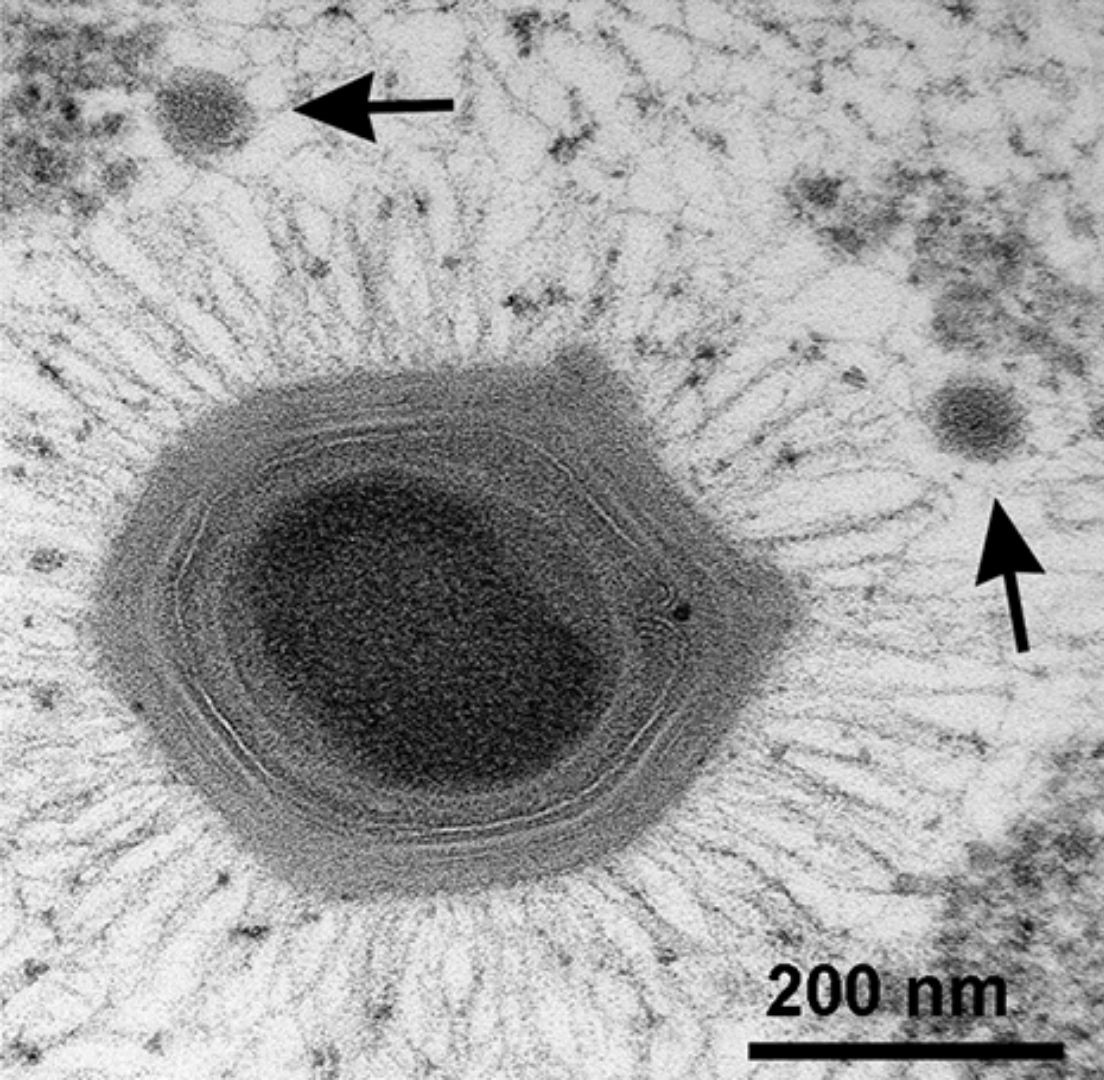
Image Source: Wikipedia
Both of the theories above assume that cells existed before viruses. But what if viruses came first? According to the third theory (the Virus-first model), since viruses are much simpler in structure than cellular life forms, they may have been among the first forms of life, and more complex cellular structures evolved later as a result of viral evolution.
Viruses Don’t Just Make Us Sick!
Although we know of about two hundred types of viruses that infect, sicken, or kill us, research has revealed that some viruses are actually beneficial to human health. A major example of this is HERVs (human endogenous retroviruses), which are viral remnants passed down from our ancestors that we’ve discovered within our own genes. These viruses play a crucial role in vital biological processes, such as placental development. For instance, the envelope protein produced by the HERV-W virus is essential for the formation of the placenta, demonstrating the significant evolutionary role these viruses have played for humanity. Additionally, some viruses can strengthen our defenses against bacterial pathogens. For example, the gamma-herpes virus supports our immune system against dangerous bacterial infections like listeriosis. The Hepatitis G virus, on the other hand, can slow the progression of HIV, potentially reducing the virus’s harmful effects.
With so many species yet to be discovered, their potential for both harm and good, and their long, debated history, there is no doubt that viruses play a significant role in the universe. Who knows? Maybe one day we’ll wake up to find all our questions answered, finally understanding the true place of viruses in nature. But for now, wrapped in the magic of the unknown and the mysterious, viruses continue to exist in our lives as both a threat and an enigma.
References and Further Reading
Dutchen, B. S. (2023, May 16). The Good that Viruses Do. Harvard Medicine Magazine. https://magazine.hms.harvard.edu/articles/good-viruses-do#:~:text=Viruses%20also%20keep%20us%20alive,disease%20and%20develop%20new%20drugs.
Khan Academy. (n.d.-a). https://www.khanacademy.org/test-prep/mcat/cells/viruses/a/are-viruses-dead-or-alive
Khan Academy. (n.d.-b). https://www.khanacademy.org/test-prep/mcat/cells/viruses/a/evolution-of-viruses
Medical Discovery News, David Niesel [dniesel@utmb.edu]. (n.d.). The good side of viruses. Medical Discovery News (Mdnews). https://www.utmb.edu/mdnews/podcast/episode/the-good-side-of-viruses
PBS Eons. (2018, June 12). Where did viruses come from? [Video]. YouTube. https://www.youtube.com/watch?v=X31g5TB-MRo
Originally published in Turkish at Doğa Filozofu.