



Imagine a creature that thrives in conditions that would end almost any other living thing: blistering heat, crushing pressure, the frozen summit of Everest, arid, bone-dry wastelands, and even the vacuum of outer space. Tardigrades are so incredibly resilient that they could likely withstand massive asteroid impacts and supernova explosions. These extraordinary creatures, which often have scientists wondering if they’ve somehow unlocked the secret to immortality, seem to rewrite the very rules of life. Their baffling abilities push researchers to reconsider the limits of where life might exist in the universe. But how exactly do tardigrades pull off such extreme stunts? Let’s dive in and get to know these remarkable survivors.
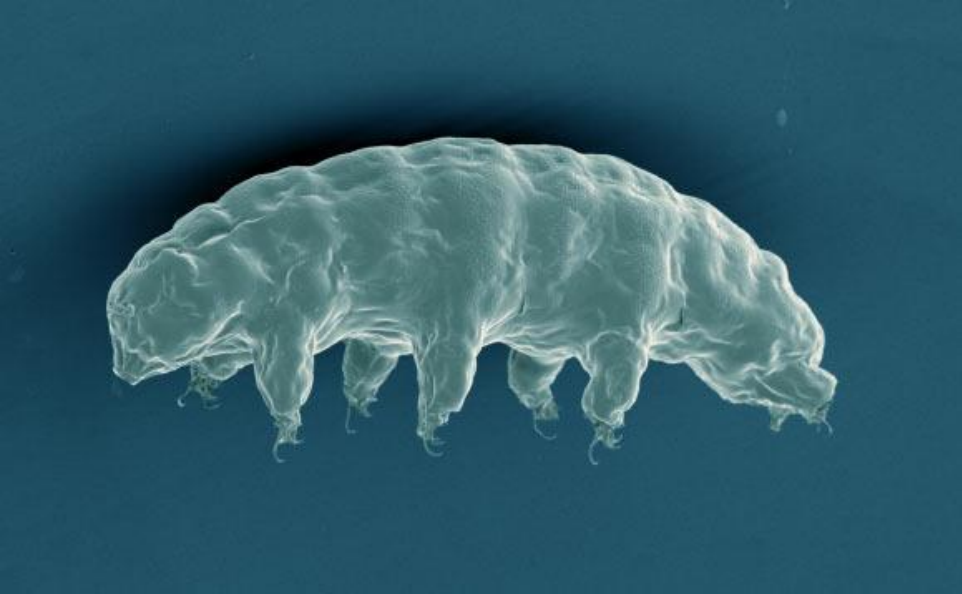
Image Source: SciNews
Tardigrades were first discovered in 1773 by German zoologist J.A.E. Goeze, and three years later, Italian biologist Lazzaro Spallanzani gave them the name “Tardigrada,” which translates to “slow walker.” Despite their ability to survive almost anywhere, they typically live in aquatic environments, using their needle-like mouthparts to feed on the fluids of plant and algae cells. These generally colorless and transparent creatures molt every 5 to 10 days, growing slightly larger with each cycle. Even though they are tiny, roughly 1,300 different species have been identified so far!
But as you might guess, these biological quirks aren’t why the scientific community is so obsessed with them. What’s truly fascinating is their defiance of nature’s harshest conditions. Among the toughest creatures on the planet, tardigrades can endure environments where almost nothing else could. They withstand high pressure, total dehydration, intense radiation, and even the vacuum of space. They can survive in a freezer for 30 years and hang on even in extreme conditions near -270°C—the lowest temperature physically possible. They are so robust they could likely shrug off many of the same disasters that would wipe out humanity.
So, if they aren’t technically immortal, how do they do it? Let’s take a closer look at the secrets behind their extraordinary resilience.
How Do Tardigrades Survive?
To understand how tardigrades handle such extreme conditions, we have to look at why and how these talents evolved. The answer is hidden in their evolutionary history.

Like many other animal groups, tardigrades first emerged in the oceans. Millions of years later, as some animals began to venture onto land, they faced a massive problem: water scarcity. Other groups evolved adaptations like waterproof skin to keep their bodies hydrated (just like we humans did). But tardigrades solved this differently. To survive, they developed the “tun” state—a form of metabolic slowdown that makes them incredibly resistant to environmental stress. In this state, tardigrades dial their metabolism down so low that they appear essentially “dead.” Yet, once favorable conditions return, they can spring back to life. This is precisely how they gained the ability to withstand dehydration, extreme temperature swings, and even radiation.
The Secret Protein That Protects Their DNA: DSUP
Okay, so they slow their metabolism to survive, but how does their DNA stay intact under such high heat and radiation? That’s where a special protein called DSUP (Damage Suppressor) enters the scene. You can think of this protein as a personal bodyguard for tardigrade DNA. In conditions where DNA would normally mutate, break, or suffer irreparable damage—especially under extreme environmental stress like radiation—DSUP steps in. It binds directly to the DNA, acting as a shield that prevents harmful molecules from reaching it or neutralizes them before they can cause damage. This significantly boosts the chances of their DNA surviving unscathed.

Tardigrades Could Be the First Interstellar Travelers!
The fact that these tiny creatures can survive heat, pressure, and even deadly radiation has turned them into an incredible source of data for space exploration. That’s exactly why, in 2007, the European Space Agency (ESA) and the TARDIS project sent these tiny survivors into space. The goal was to see if they could withstand the harsh conditions of space by entering their “tun” state. About 3,000 tardigrades spent 12 days in space after being launched on a rocket from Kazakhstan. The results showed that they not only survived these extreme conditions but were even able to reproduce. Furthermore, in a 2011 experiment, tardigrades were exposed to prolonged cosmic radiation in space and still managed to survive and return to an active state.

These experiments led scientists to a brilliant idea: send tardigrades on an interstellar journey! The plan is quite exciting. Before launching them into deep space, we could put them into their “tun” state, effectively pausing their metabolism. Sensors on the spacecraft would allow us to “wake them up” by rehydrating them whenever needed. Afterward, researchers could study how many survived, what changes occurred in their cells or behaviors, and whether there were any genetic shifts. This experiment could provide a massive contribution to science and potentially open entirely new doors for space exploration.
As one of nature’s most robust and unusual creatures, tardigrades offer us a truly astonishing glimpse into the limits of survival. The resilience shown by these tiny beings reshapes not just our understanding of biology, but also our perspective on the possibilities of life in the universe. Who knows? Perhaps one day, the survival secrets of the tardigrade will inspire new breakthroughs for humanity and our search for life among the stars!
References and Further Reading
Academic Press. (2023, February 28). The tardigrade damage suppressor protein Dsup promotes DNA damage in neurons. Molecular and Cellular Neuroscience. https://www.sciencedirect.com/science/article/abs/pii/S1044743123000209
Hashimoto, T., & Kunieda, T. (2017, June 15). DNA protection protein, a novel mechanism of Radiation tolerance: Lessons from Tardigrades. Life (Basel, Switzerland). https://pmc.ncbi.nlm.nih.gov/articles/PMC5492148/
Sci.News. (2025, April 15). Newly-Discovered Mechanism Explains How Tardigrades Survive Extreme Dehydration. Sci.News. https://www.sci.news/biology/tardigrade-dehydration-11179.html
Tardigrades could be the first interstellar space travellers. BBC Science Focus Magazine. (2022, March 31). https://www.sciencefocus.com/space/tardigrades-first-interstellar-space-travellers
Wall, M. (2024, April 11). New tardigrade species reveals clues to surviving lethal space radiation. Space.com. https://www.space.com/the-universe/new-tardigrade-species-reveals-clues-to-surviving-lethal-space-radiation
Weisberger, M. (2024, September 12). Tardigrades: Facts about one of the hardiest animals on Earth, and beyond. LiveScience. https://www.livescience.com/57985-tardigrade-facts.html#section-discover-more-about-tardigrades
Originally published in Turkish at Doğa Filozofu.