



If you’re the type who likes to touch plants while out on a hike, you’ve likely run into this painful surprise: the stinging nettle. Its Turkish name, ısırgan, comes from an old root meaning “the one that bites,” and it certainly lives up to the reputation. Let’s dive in and explore why the nettle “bites” and the chemistry hiding behind that sting!
The Plant That Burns: Stinging Nettle
The scientific name for stinging nettle is Urtica, derived from a Latin word meaning “to burn” or “to sting.” The moment the tiny needles on its surface touch your skin, they trigger a sensation similar to a bee sting, which can last for hours. Just like animals, plants have evolved defense mechanisms to ward off external threats and improve their chances of survival. The stinging nettle is one of the most famous defenders in the plant kingdom. They develop these powerful defenses chemically. So, what exactly is brewed in the poison factory of this plant that clearly doesn’t like being touched?
A Defense Industry Inside the Plant: The Internal Chemistry Lab
Each of the hair-like structures on the surface of a stinging nettle acts like a hypodermic needle. Once they pierce the skin, they inject stinging chemicals directly into your body. Resembling a lab run by expert chemists, this plant skillfully manufactures a potent cocktail including formic acid, histamine, acetylcholine, serotonin, tartaric acid, and oxalic acid.
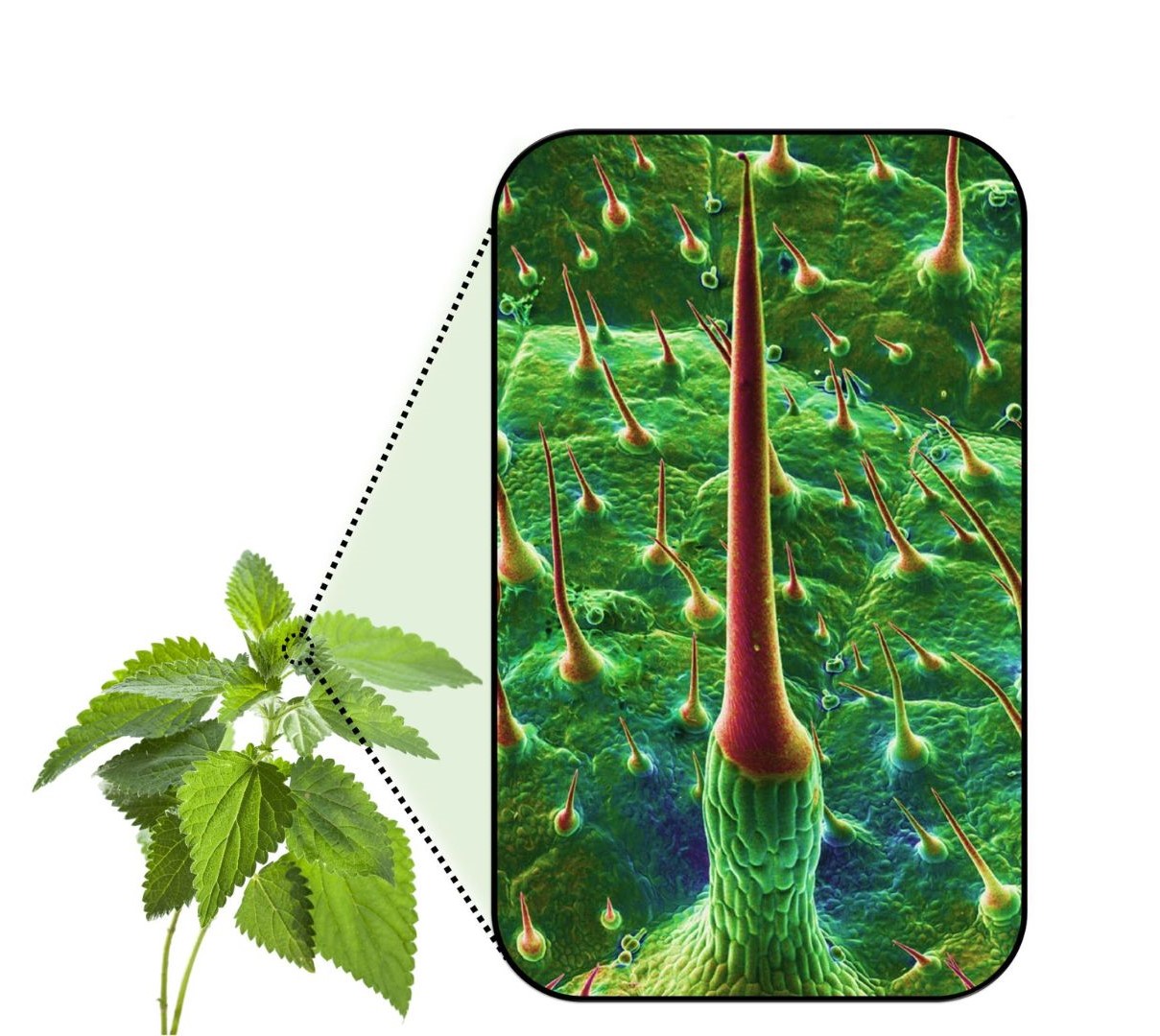
Image Source: Pubmed (Mustafa et al., 2018)
The star of the show among these chemicals is formic acid—or, as you might know it, ant acid. It earned that name because it was first discovered in the secretions of ants. The burning sensation from ant bites and even bee stings is primarily caused by this very chemical.
However, the nettle releases formic acid in quite low concentrations. “Knowing” that it wouldn’t be effective enough on its own, it recruits histamine, acetylcholine, and serotonin to the front lines. When these chemicals work together, they cause intense burning and pain. But for a truly high-level defense, the deterrent needs to last a while. That’s where chemicals like tartaric acid and oxalic acid step in, ensuring the burning sensation lingers.
Why Do These Chemicals Cause Pain? An Introduction to Toxicology
So, why do these chemicals actually hurt? Let’s take a quick dip into the science of toxins. When we look at the chemicals that cause that stinging sensation, we see that most are acidic: formic acid, tartaric acid, and oxalic acid. And let’s not forget that formic acid is the main contributor here.
Our bodies aren’t built to handle environments that are too acidic or too basic; they get damaged and start to react, which is why we feel the burn and the itch. The first thing to do in this situation is to use plenty of water to neutralize the acidic environment. Water dilutes the acid, making it less harmful. That’s why rinsing the area with water for a good while should be your first step. Beyond that, we can neutralize the acidic surface with mild bases. One of the best solutions for a nettle sting is soap. Being basic, soap reacts with the acid on the skin to neutralize it. Usually, washing the area with soap and water is enough for the burning sensation to fade or disappear within a few hours.

What Else Can Be Done to Reduce the Effect?
The most important rule in creating an antidote is knowing exactly what chemicals are in the toxin. This is why, whether it’s a stinging nettle, an insect bite, or a snake bite, knowing the species is critical for proper treatment. Not every poison is acidic; while basic substances like soap work on acidic toxins, the situation is the exact opposite for basic toxins. Furthermore, as we see with the nettle, beyond the direct effects of the acids, we also need to deal with other molecules like histamine.
This is where various medications come into play. For instance, antihistamines are used for issues caused by histamine. When there’s an unexpected surge of histamine in our bodies, the alarm bells start ringing, leading to symptoms like itching and redness. We need allergy medication to turn off these alarms and send an “all clear” message to our body. Allergy meds are mostly antihistamines that block the receptors where histamine would normally attach, aiming to reduce the allergic reaction. If you’re interested in the topic of allergies, you can also check out our article: “Why Do Some People Have Food Allergies?“
Bonus: The Connection Between Urticaria (Hives) and Stinging Nettle
As we mentioned at the beginning, the Latin name for the stinging nettle, Urtica, means “to burn.” This word is also the origin of the skin condition known in the medical world as “urticaria.” Characterized by itching and redness, urticaria is essentially the medical term for the effect the stinging nettle leaves on the skin. In other words, the condition we commonly call “hives” shares the same etymological root as the stinging nettle itself.

References and Further Reading
Benton, E. (2024, January 11). What is stinging nettle rash? Health. https://www.health.com/condition/skin-conditions/stinging-nettle-rash#:~:text=The%20hairs%20on%20the%20plant,similar%20to%20a%20bee%20sting.
ısırgan – Nişanyan Sözlük. (n.d.). Nişanyan Sözlük. https://www.nisanyansozluk.com/kelime/%C4%B1s%C4%B1rgan#
Kelime kökeni, kelimesinin anlamı – etimoloji. (n.d.). https://www.etimolojiturkce.com/arama/S%C4%B1rgan
LeBaron-Botts, P., & LeBaron-Botts, P. (2019, April 26). Two burning houses: A natural history of stinging nettle – North Cascades Institute. North Cascades Institute – Connecting people, nature, and community since 1986. https://blog.ncascades.org/naturalist-notes/two-burning-houses-a-natural-history-of-stinging-nettle/
Mustafa, A., Ensikat, H., & Weigend, M. (2018). Stinging hair morphology and wall biomineralization across five plant families: Conserved morphology versus divergent cell wall composition. American Journal of Botany, 105(7), 1109–1122. https://doi.org/10.1002/ajb2.1136
Sissons, B. (2020, June 30). Stinging nettle rash: Side effects, prevention, and treatment. https://www.medicalnewstoday.com/articles/stinging-nettle-rash#treatments
The chemistry of stinging nettles. (2016, May 20). Compound Interest. https://www.compoundchem.com/2015/06/04/nettles/
Originally published in Turkish at Doğa Filozofu.