



Think back to a winter day when you were waiting for the bus, shivering to your core. You felt like it couldn’t possibly get any colder, right? Even though the temperatures we experience are nothing compared to the depths of space, there is actually a hard limit to how cold things can get: absolute zero. This is the lowest possible temperature in the universe, defined as zero Kelvin (0 K). But as we approach absolute zero, matter starts to behave in ways that are downright bizarre. At this point, we move past the four states of matter we know and stumble upon a phenomenon that shook the scientific world: the fifth state of matter. So, what exactly is absolute zero? How does this fifth state form? Let’s dive into these mysterious, fascinating concepts together.

What Is Absolute Temperature?
In plain English, temperature is just a measure of how hot or cold a system is. In scientific terms, it is a measure of the kinetic (movement) energy of matter. The value we read on a thermometer or calorimeter is essentially showing us how much the atoms in a substance are jiggling around.
Most of the world, including Turkey, uses Celsius (°C), while the U.S. and a few other places stick to Fahrenheit (°F). In the scientific community, however, we use the Kelvin (K) scale. Absolute temperature refers to the minimum possible value temperature can reach, which is 0 Kelvin (or -273.15°C). But what is 0 Kelvin really? Why is -1 Kelvin scientifically impossible?

As we mentioned, temperature is kinetic energy. Think of a cell at 15°C as a well-behaved child, and a cell at 150°C as a hyperactive kid who can’t sit still. The thermometer is just an indicator of their “mischief” level—their movement energy. Now, imagine 0 Kelvin. We are assuming the cell has stopped moving entirely; its kinetic energy is zero. It’s like a child who is perfectly still, having absolutely no energy left to move.
So, what happens if we try to go even lower? Here’s the catch: How can an object have negative movement energy? It’s logically impossible for something to be “more still” than completely stationary. That is why science defines 0 Kelvin as absolute zero and tells us it is physically impossible to go below it.
Approaching Absolute Zero and the Fifth State of Matter
We’ve established that as we approach absolute zero (0 K), molecular motion grinds to a halt. At these ultra-low temperatures, the kinetic energy of atoms drops to near-zero, meaning they lose the ability to bounce around or collide. Because there is almost no kinetic energy transfer between atoms, they stop interacting. This causes the atoms to clump together. We no longer have thousands of individual atoms moving randomly; instead, we have a “super atom” where all the matter behaves in unison. Think of it like an army of ten thousand soldiers moving in perfect synchronization.
This process creates what we call a Bose-Einstein Condensate. In this state, the behavior of the atoms is governed by quantum mechanics, and they all share the same quantum state. This matter exhibits superfluid properties, meaning it has zero viscosity. For those who aren’t familiar, viscosity is basically a fluid’s resistance to flowing. Zero viscosity means the fluid flows without any resistance and without losing any kinetic energy. This makes the matter act in very strange ways—it can climb up the walls of its container or even leak through microscopic cracks that a normal liquid wouldn’t dream of passing through.
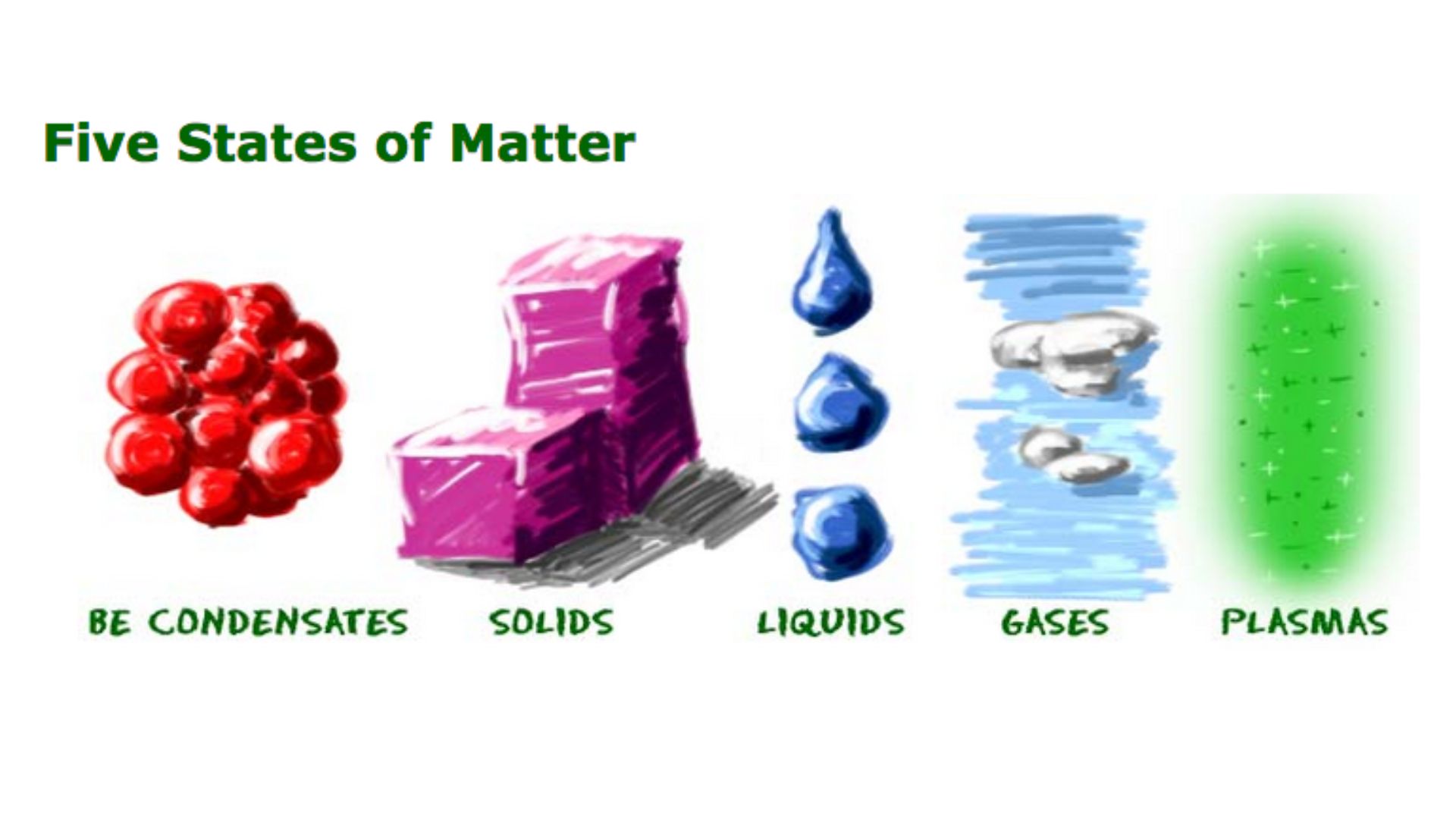
Normally, as temperature rises, atoms move more freely and each goes its own way. But as we get close to 0 Kelvin, every atom begins to move in perfect sync. They move with such harmony that they stop being individual entities and act as a single whole. They effectively move as one giant atom. This extraordinary state is what we call the fifth state of matter.
This state is a quantum superposition that transcends the other four states of matter (solid, liquid, gas, and plasma). It is a quantum state where atoms are perfectly synchronized and start to deviate from the laws of classical physics. Phenomena like the Bose-Einstein Condensate can really only be observed in laboratory settings because these extreme temperatures require very specific, controlled conditions. However, these discoveries have given us a brand new perspective on the nature of matter and have proven the existence of this fifth state.
Bose-Einstein Condensates and Their Applications
While getting close to absolute zero is an incredibly difficult and energy-intensive process, this new state of matter has some pretty cool potential. As we approach absolute zero, the electrical resistance of materials drops dramatically. This is leading to breakthroughs in superconductors, allowing for high-efficiency energy transfer without any power loss. These discoveries are also making significant contributions to the development of quantum computer technology.

Now that we have a better grasp of what absolute temperature is and how the fifth state of matter forms, it’s still pretty hard to wrap our heads around it. Plus, the fact that creating such low temperatures requires massive amounts of energy means Bose-Einstein condensates are, for now, confined to the lab. But scientists are constantly searching for new materials that might exhibit these super-atom behaviors at more accessible temperatures. Who knows? In the not-too-distant future, these quantum states—which we can barely imagine right now—might be tucked away inside our devices and woven into our daily lives!
References and Further Reading
Bagley, M. (2023, October 6). States of matter: Definition and phases of change. livescience.com. https://www.livescience.com/46506-states-of-matter.html
Emspak, J., & Ghose, T. (2024, March 29). Bose-Einstein condensate: The fifth state of matter. livescience.com. https://www.livescience.com/54667-bose-einstein-condensate.html
StarTalk. (2022, October 18). Bose-Einstein Condensate: the state of matter you never learned about [Video]. YouTube. https://www.youtube.com/watch?v=lVgRckBICwI
The Editors of Encyclopaedia Britannica. (2006, September 28). Absolute temperature scale | Definition & Facts. Encyclopedia Britannica. https://www.britannica.com/science/absolute-temperature-scale
Originally published in Turkish at Doğa Filozofu.