
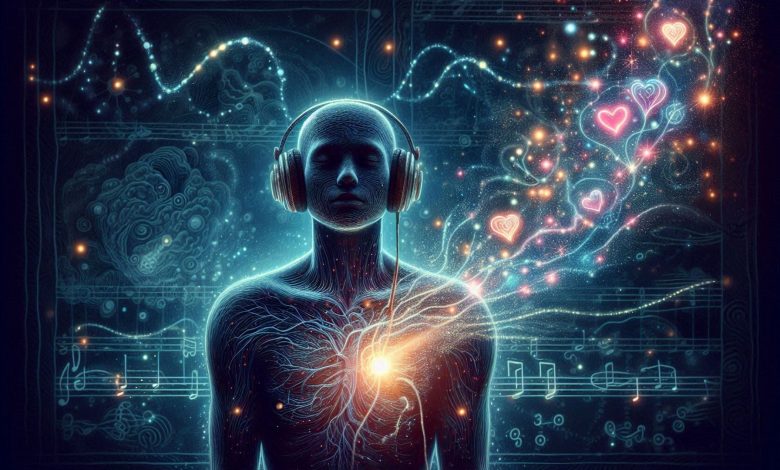
We’ve all been there: you pop your headphones in, and the moment that first melody hits, time just stops. A shiver runs down your spine, your hair stands on end, your eyes well up, and there’s that familiar lump in your throat—as if the music is physically echoing inside your heart. But why? Is it just the lyrics, or is it the melody that hits us so deep? What exactly is happening in our brains at that moment? Music isn’t just sound waves passing through our ears; it’s a journey that reaches our very soul. In this piece, let’s dive in and explore why certain songs trigger such intense physical and emotional reactions.
Putting that sudden chill or tingling sensation into words can be tricky. But it’s such a universal experience that it actually has a name: frisson. This French-derived term translates to “shiver” or “thrill.” It describes the physical reaction—goosebumps, a sudden internal tremor, or teary eyes—that we get when faced with a powerful moment in music, art, or raw emotion.
Frisson has been the subject of research for quite some time, and the scientific community has pinpointed the culprit: dopamine. When that peak musical moment hits, our brain’s reward center lights up, triggering a sudden release of dopamine. Since dopamine is the chemical linked to pleasure and reward, this surge causes the body to react physically: your heart rate speeds up, your breathing shifts, and yes—your hair stands on end.

The science is clear: it’s dopamine. But the question we’re really dying to answer is: What exactly about a song drives our brain to react so powerfully? Let’s take a look at the likely suspects.
- The Expectation Mechanism
This is the biggest driver of frisson. As we listen to music, we’re constantly, and mostly subconsciously, predicting the rhythm and melody based on our innate musical intuition. When the music defies those expectations—especially by hitting a sudden, unexpected high note—it catches our brain off guard. That “plot twist” is what gives us the shivers. Some scientists believe this is rooted in evolutionary biology.
- String Instruments
Every instrument has its own unique way of tugging at our heartstrings, but string instruments are particularly good at triggering frisson. Why? Because they vibrate at frequencies very similar to the human voice. The timbre of a violin or cello resonates closely with our own vocal range. Our brains tend to register this similarity as something “significant” or “emotional” without us even realizing it. When that subtle familiarity of a human-like tone meets a surprising musical shift, it creates a powerful, unforgettable sensory experience.
- Emotional Memory and Personal History
When lyrics mirror our own lives—our happiest moments or our deepest heartbreaks—it’s nearly impossible not to get chills. Our brains are hardwired to link songs to specific chapters or memories in our lives. So, the moment you hit play, the melody and the memory collide. And before you know it, you’ve got goosebumps.
The intense emotions we feel while listening to music overlap significantly with the areas of the brain that light up when we’re in love or receiving a reward. It goes to show that music triggers the exact same chemical reactions in our brains as the most powerful emotional experiences of our lives.
We’ve covered the triggers, but there’s one more burning question: are you more likely to get frisson from a happy song or a sad one?
A fascinating study on this was conducted by PhD candidate Rémi de Fleurian and Lecturer Dr. Marcus Pearce at the Music Cognition Lab at Queen Mary University of London. They analyzed 988 songs known to trigger piloerection (goosebumps) to see if they could map out the musical DNA of the phenomenon, comparing these tracks against less “chilling” songs by the same artists.

The results were striking: sadder, slower-tempo, and more complex songs were much more likely to give people goosebumps. These tracks also contained more moments that violated or exceeded the listener’s musical expectations—those surprise melodic shifts or unexpected harmonies. This confirmed that violating musical expectation is the strongest trigger for piloerection.
Perhaps the reason music affects us so deeply is that we find ourselves within it. A piece of us is hidden in every note; a memory, a feeling, a longing… The moments we call frisson are actually the moments we are closest to our true selves. Moments where we find ourselves in a note or a melody. Now that you’ve read this, you probably won’t be so surprised the next time a song brings you to that state.
References and Further Reading
Frisson: Why music can give you chills or goosebumps. (2023, February 6). [Video].https://www.bbc.com/reel/video/p0dgrs1l/frisson-why-music-can-give-you-chills-or-goosebumps
Funnell, R. (2022, June 3). This playlist will give you “Skin orgasms” thanks to Frisson. IFLScience. https://www.iflscience.com/this-playlist-will-give-you-skin-orgasms-thanks-to-frisson-63867
Harrison, L., & Loui, P. (2014). Thrills, chills, frissons, and skin orgasms: toward an integrative model of transcendent psychophysiological experiences in music. Frontiers in Psychology, 5. https://doi.org/10.3389/fpsyg.2014.00790
Do you get goosebumps while listening to music? | E-Psikiyatri. (n.d.). https://www.e-psikiyatri.com/muzik-dinlerken-tuyleriniz-diken-diken-oluyor-mu?utm_
Robson, D. (2022, February 24). The strange phenomenon of musical “skin orgasms.” https://www.bbc.com/future/article/20150721-when-was-the-last-time-music-gave-you-a-skin-orgasm
Originally published in Turkish at Doğa Filozofu.